Inside the Enclosure: Evaluating Industrial Sheet Metal Laser Infrastructure
When walking a precision fabrication facility, the view through the safety glass of an enclosed flatbed cutting cell tells you far more about operational discipline than a sales brochure ever could. Whether an operations team is auditing a subcontract supplier or reviewing an internal tooling investment, understanding how an Amada laser cutting workshop and equipment environment manages motion, beam delivery, and thermal load across full-format sheets is critical for predictable part cost and edge quality.
A modern flatbed CNC laser cutting cell is designed around containment, high-speed contouring, and mechanical defense against hostile cutting debris. Looking inside the working envelope reveals a tightly choreographed balance between dynamic mechanical axes, optical focus assemblies, and consumable workholding surfaces.
Core Mechanical Assemblies Inside the Cutting Chamber
The interior of a heavy-duty flatbed sheet metal cutter is exposed to continuous heat, abrasive fumes, and molten metal splatter. The survivability of the machine and the repeatability of cut parts depend directly on how well critical components are isolated and controlled.
1. The Cutting Head and Z-Axis Positioning Unit
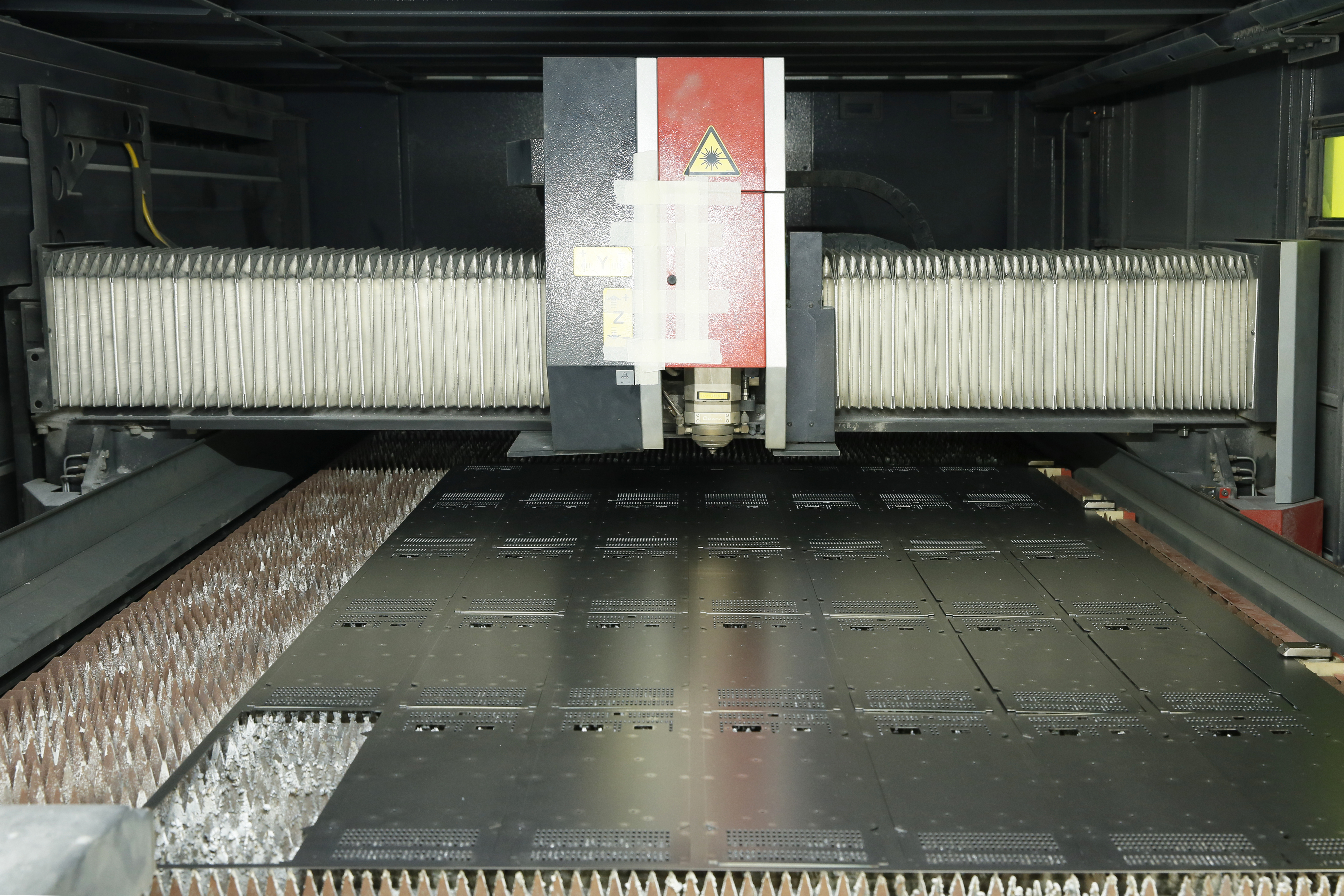
The cutting head carriage, typically mounted to a high-speed gantry spanning the Y-axis, carries both the optical focus package and the mechanical Z-axis drive. This vertical axis does not simply set a static start height; it actively tracks surface undulations in real time using non-contact capacitive height sensing. Even minor sheet waviness or internal stresses that cause plate warping during thermal cutting must be accommodated instantly by the nozzle assembly to maintain consistent beam focus and assist-gas pressure at the kerf.
2. Way Covers and Bellows Protection
Visible along the gantry bridge are heavy-duty, accordion-style bellows running the width of the axis. Laser cutting generates fine airborne particulate and microscopic iron oxide or metal dust that can quickly destroy precision ball screws and linear guideways. These bellows act as the front line of mechanical preservation. A shop that neglects cracked or sagging bellows will inevitably experience micro-chatter along cut edges and premature drive failure.
3. The Slatted Support Table and Dross Accumulation
Beneath the raw sheet metal plate lies the slatted bed. These replaceable steel or copper slats support the raw stock while allowing dropped scrap, molten slag, and cutting gas to escape cleanly beneath the workpiece. Over continuous production runs, slats inevitably accumulate heavy dross and slag deposits. If a shop does not routinely clean, de-slag, or rotate these slats, molten blow-back can weld cut components back into the skeleton, tilt small parts upward into the path of the traveling nozzle, or cause edge pitting on the bottom surface of the workpiece.
Nesting Dynamics: High-Density Perforations and Structural Integrity
A common operational sight on a flatbed cutter is a full-format sheet nested with dense grids of ventilation slots, perforated hole patterns, and perimeter cutouts destined for electrical cabinets or machinery guards. Running high-density repetitive patterns requires deliberate programming strategies.
Every pierce introduces localized thermal input into the sheet. In repetitive punch-like laser operations, concentrated heat can lead to sheet warping or localized expansion if the nesting algorithm cuts sequentially from one end of a dense grid to the other. Experienced programmers distribute the pierce sequence across sections of the panel, allowing heat to dissipate before executing final outer contour cuts. Additionally, micro-jointing or tabbing becomes necessary on smaller nested parts to prevent them from tilting upward into the cutting head as the skeleton separates.
What Sourcing Teams Must Clarify Before Awarding Work
You cannot gauge the precise capabilities of a laser cutting workshop simply by watching the gantry move. Sourcing managers and manufacturing engineers should explicitly confirm several key variables that cannot be determined by visual inspection alone:
- Laser Source and Power: An enclosed cabinet can house either a conventional CO2 resonator or a high-efficiency solid-state fiber laser engine. Laser wattage (ranging commonly from 2 kW up to 12 kW or higher) dictates maximum clean-cut thickness in mild steel, stainless steel, and aluminum, as well as production throughput on thin gauge sheet.
- Assist Gas Configuration: Nitrogen provides a clean, oxide-free edge that is immediately ready for welding or powder coating without secondary grinding, but at a higher operational cost. Oxygen facilitates faster burning in thicker carbon steels but leaves a hard oxide layer. Verify which gas is specified on your part prints.
- Achievable Tolerances: While linear drive positioning might be rated within fractions of a millimeter under factory conditions, real-world cut tolerances depend on material thickness, thermal buildup across the sheet, and slat cleanliness. Request verified inspection data on parts of comparable geometry rather than relying solely on machine data sheets.
Practical Checklist for Auditing a Sheet Metal Cutting Line
When conducting an on-site audit of a contract fabricator or reviewing newly installed laser infrastructure, pay close attention to shop-floor housekeeping and maintenance routines:
- Check the condition of the table slats: heavy dross buildup indicates delayed maintenance cycles that can lead to part tipping and nozzle crashes.
- Inspect the enclosure's exhaust and filtration system: insufficient draft allows particulate to settle on machine rails and bellows covers.
- Review skeleton scrap handling: well-organized off-cut management and systematic remnant storage reflect tight inventory and material-yield control.
- Ask about nozzle inspection schedules: worn, pitted, or off-center nozzles degrade beam centering and lead to dross hanging from cut edges.
Frequently Asked Questions
Why is total machine enclosure required for modern sheet metal lasers?
Enclosed housings are critical for personnel safety and environmental containment. Solid-state fiber lasers operate at a wavelength (around 1 micron) that can cause catastrophic retinal damage even from diffuse reflections, necessitating certified interlocked safety cabins. Furthermore, high-velocity assist gases aerosolize metal particulate, which must be captured and extracted through dedicated filtration systems.
How does slat dross impact part quality?
Excessive dross buildup on bed slats reduces the support area and causes the raw sheet to sit unevenly. When the laser cuts directly over a heavily slagged slat point, molten metal can splash back against the bottom face of the cut, creating bottom-edge burrs or welding the slug to the finished profile. It can also cause cut parts to sit proud, risking a high-speed collision with the cutting head.
Next Steps for Fabrication Buyers
If you are evaluating suppliers running sheet metal laser cutting lines, do not settle for general machine brand lists. Request their standard operating tolerances by material gauge, clarify whether edge deburring is included in quoted rates, and confirm assist-gas selection for parts destined for downstream surface finishing. Verifying these details early prevents unexpected post-processing costs and ensures smooth assembly downstream.