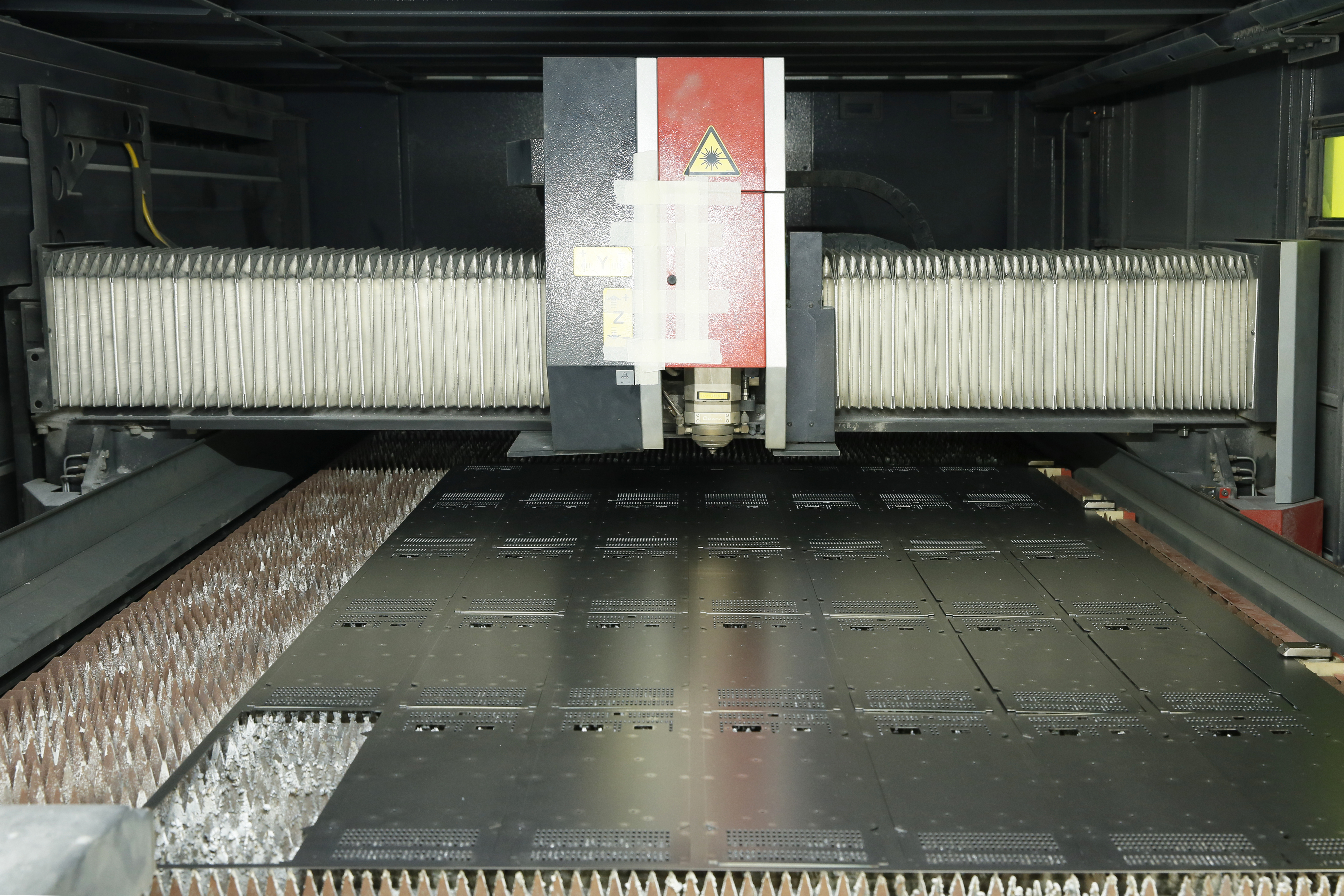
When packaging high-voltage battery modules, auxiliary power units, or commercial electrification systems, specifying structural components for energy storage forces an immediate balance between mechanical rigidity, dielectric isolation, and factory floor assembly speed. Too often, the conversation around energy storage focuses strictly on cell chemistry or thermal runaway mitigation. Yet, the unglamorous mechanical backbone—the junction boxes, mounting trays, and power-distribution housings that route heavy DC feeds alongside sensitive CAN-bus communication—is where field reliability is actually won or lost.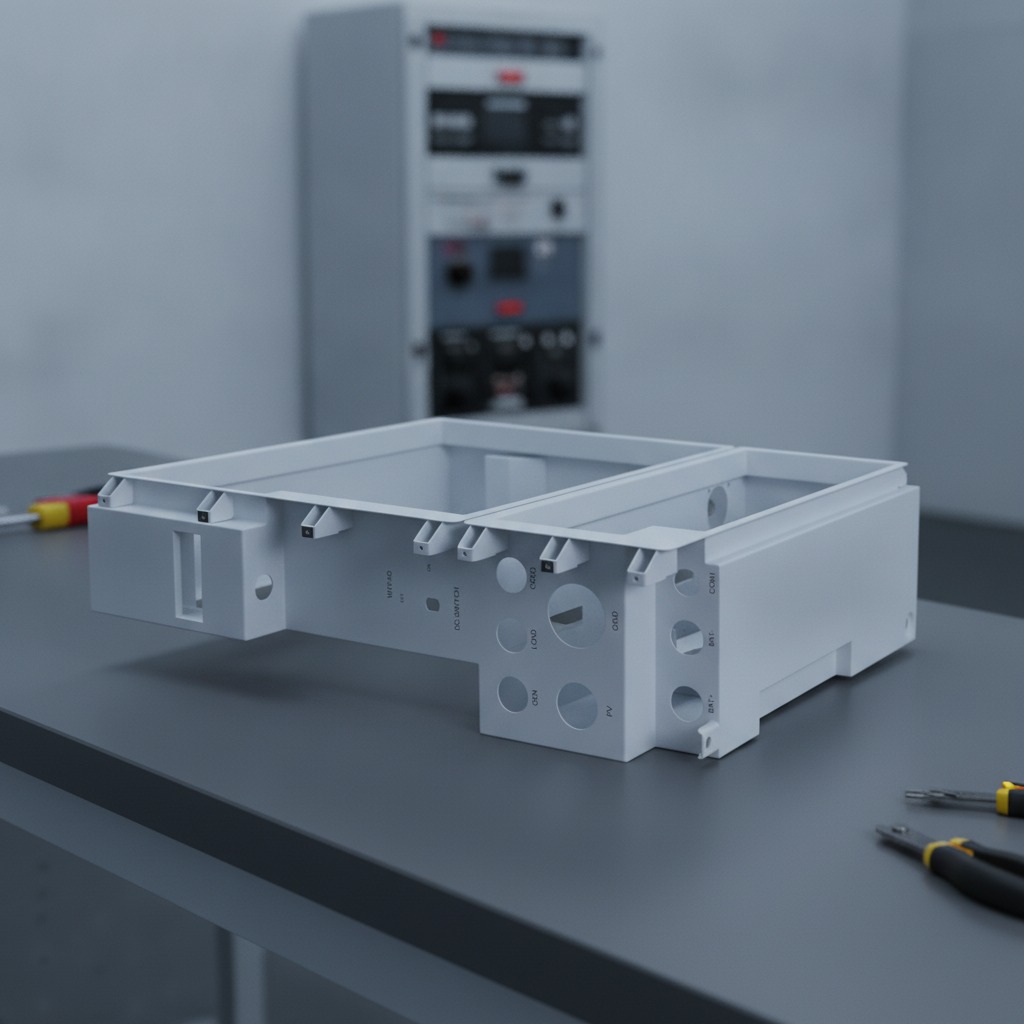
A failed structural enclosure or an improperly supported terminal block introduces catastrophic risks: arcing, ingress, connector strain under vibration, and painful assembly line bottlenecks. For sourcing engineers and mechanical packaging leads, evaluating molded polymer enclosures requires looking past cosmetic samples and interrogating how geometry handles electrical clearance, mechanical load, and thermal movement over thousands of operational hours.
The Architecture of an Electrical Distribution Housing
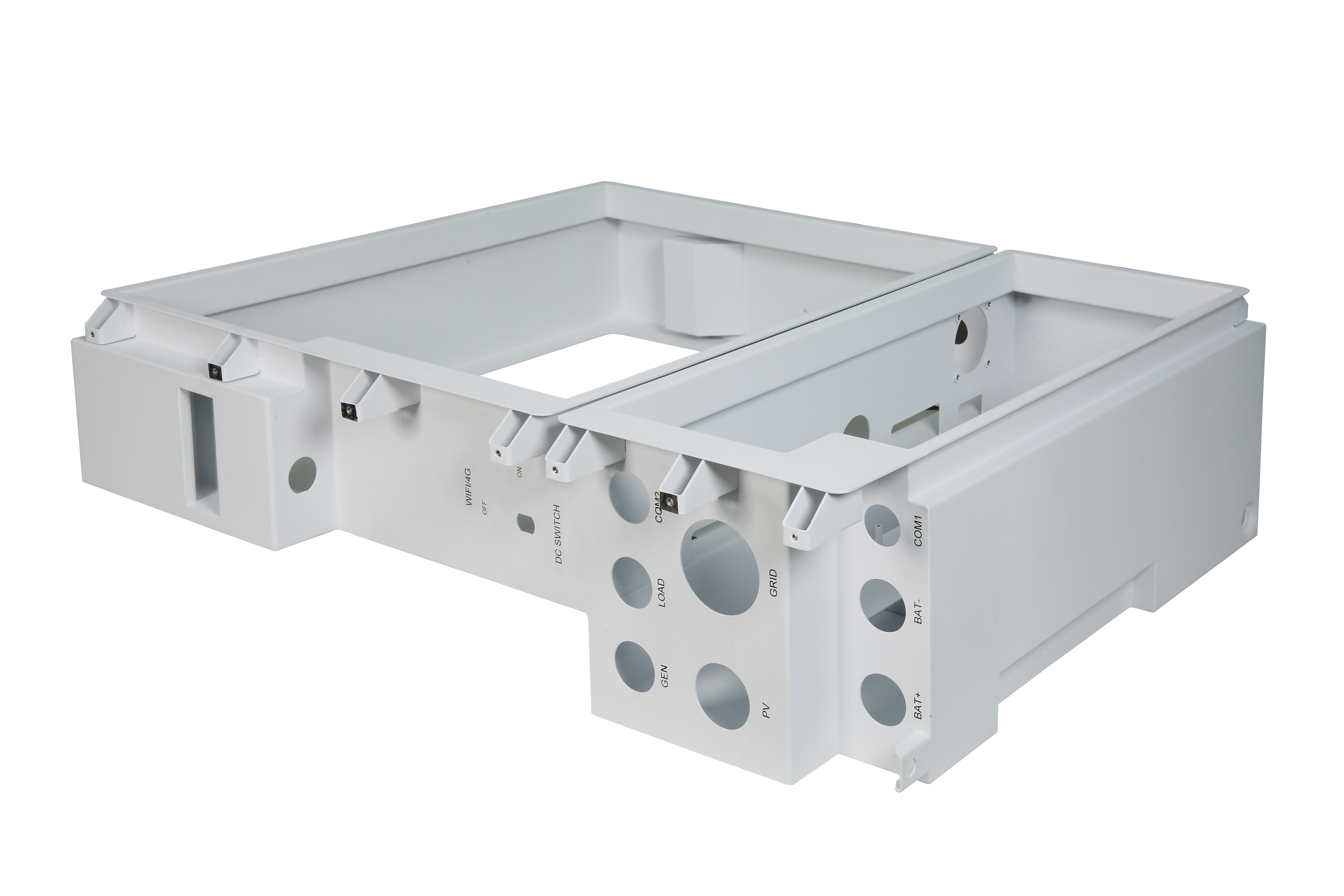
Take a close look at dedicated power-distribution and junction housings used across mobile equipment and stationary battery setups. A typical bare enclosure—often molded in a neutral gray engineering polymer—features a deceptively complex layout intended to consolidate high-power and low-voltage paths in a single footprint.
Key features visible on such structural housings include:
- Multi-circuit separation: Dedicated physical zones labeled for heavy DC connections (such as BAT+, BAT−, LOAD, and GEN) positioned intentionally away from signal routing.
- Communication pass-throughs: Molded or punched ports designated for control wiring (such as COM1 and CAN2 lines), ensuring high-voltage busbars and sensitive twisted-pair communication do not interfere with one another physically or mechanically.
- Integrated switch provisions: Recessed pockets or cutouts sized for a manual DC disconnect or service switch, allowing an operator to isolate the battery pack without dismantling the cabinet.
- Chassis grounding bosses: Molded standoffs or clearance pockets marked for chassis ground (GRD) to bond the internal assembly safely to vehicle or container frames.
The internal geometry of these housings typically incorporates a network of internal partitions, floor ribs, and standoff bosses. These are not merely decorative; they serve as structural ribs that resist wall deflection when heavy battery cables are torqued down during harness installation.
Molded Polymers vs. Fabricated Metal Enclosures
Engineers frequently weigh whether structural components for energy storage junction boxes should be stamped and welded from sheet metal, cast in aluminum, or injection-molded from engineering thermoplastics. While cast aluminum offers superior EMI shielding and inherent flame resistance, molded polymer enclosures hold distinct advantages in vehicle and modular machinery applications.
First is dielectric isolation. An injection-molded polymer enclosure acts as a non-conductive barrier right out of the tool. In tight vehicle packaging where busbars or power terminals sit millimeters from enclosure walls, an insulating body eliminates the need for secondary Nomex liners or mylar insulators that add manual labor and risk tearing during servicing.
Second is feature integration. A single injection mold can incorporate perimeter rim steps for gasket seating, mounting tabs with locating pins, snap-fit harness brackets, and molded-in terminal labeling in one continuous shot. Fabricating the equivalent in sheet metal requires secondary punching, press-nut insertion, powder coating, and silk-screening or laser etching for terminal identifiers.
However, molded enclosures demand upfront caution. Polymers exhibit creep under sustained mechanical stress and undergo dimensional changes across wide operating temperatures. If a housing is rigidly bolted to a heavy machinery chassis without taking thermal expansion into account, the mounting ears can crack under severe shock or cyclical thermal loading.
Critical Evaluation Points for Sourcing and Integration Teams
When reviewing prototype housings or tooling quotes from an enclosure supplier, the CAD model rarely tells the whole story. Sourcing teams and DFM engineers should scrutinize several mechanical interfaces before signing off on production tooling:
1. Wall Thickness Uniformity and Gate Placement
Deep-draw enclosures with varied wall sections often suffer from sink marks and post-mold warpage. If the raised perimeter rim warps even a fraction of a millimeter across a 300 mm span, an applied gasket will not seal evenly against the mate cover, compromising moisture protection in harsh under-hood or outdoor environments.
2. Torque Retention on Fastener Mounts
High-power connections (BAT+, LOAD) require substantial tightening torque to prevent micro-arcing across cable lugs. An unreinforced plastic boss will cold-flow under that load over time. Sourcing teams must verify whether the housing relies on threaded brass inserts, through-bolts with backing plates, or direct self-tapping screws—the latter being a common failure point in high-vibration equipment.
3. Retention Tabs and Side-Wall Port Geometry
A housing featuring multiple circular and rectangular side openings demands precise tool coring. Projecting snap tabs or retention slots around these cutouts must provide enough mechanical compliance to accept wire seals and connector headers without snapping during cold-weather assembly.
Common Implementation Mistakes
A frequent misstep during pack integration is treating the distribution housing purely as a protective shell rather than a load-bearing member. When thick 2/0 or 4/0 battery cables exit the housing side ports, vehicle vibration translates substantial dynamic load onto the enclosure walls. If strain relief is not integrated within inches of the exterior wall, the perimeter seal will flex, open up micro-gaps, and permit road spray or condensation to accumulate inside.
Another routine oversight involves neglecting cover retention strategy. A large open-top housing requires consistent clamping pressure along its perimeter rim. Relying on only four corner fasteners on a medium-to-large footprint almost guarantees center-span bowing under internal thermal pressure or gasket push-back.
Supplier Engagement Checklist
Before issuing a purchase order for custom or semi-custom structural components for energy storage, clarify the following technical gaps with your manufacturing partner:
- Resin specification: Has the specific resin grade been validated for flammability, relative temperature index, and chemical resistance against automotive coolants or industrial battery fumes?
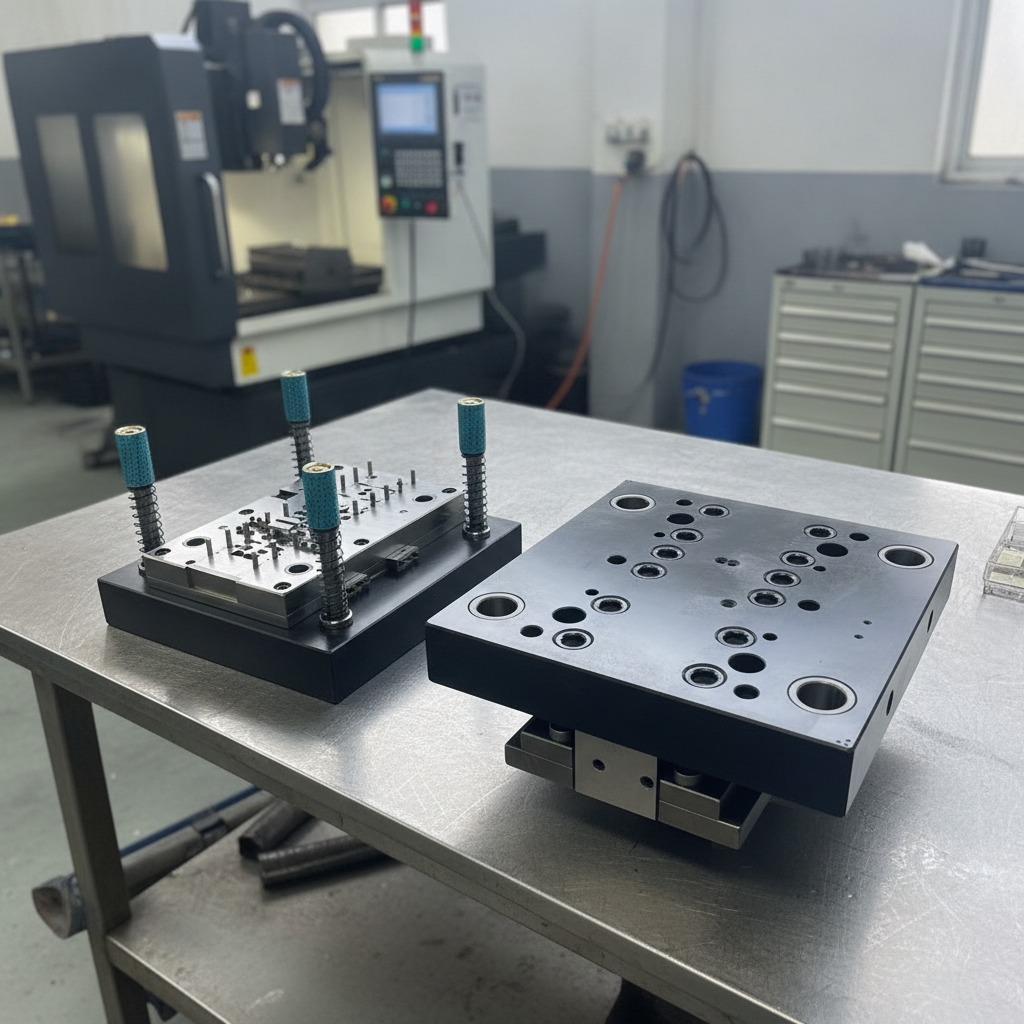
- Tooling approach: Are port knockouts handled via interchangeable mold inserts, or will secondary CNC milling be required for application-specific connector variations?
- Sealing design: Is the perimeter rim sized for a dispensed polyurethane/silicone gasket, or does it require an elastomeric O-ring cord with molded retention ribs?
- Traceability: Are critical connection labels (BAT, GRD, CAN) molded directly into the tool steel, or will they rely on applied labels that might degrade over time?
Frequently Asked Questions
Can standard off-the-shelf junction enclosures replace custom-molded housings?
Off-the-shelf industrial enclosures work well for stationary prototype systems or low-volume stationary power walls. However, they rarely feature the compact footprint, internal mounting standoffs, and pre-configured terminal pathways needed for high-vibration mobile platforms, often requiring extensive secondary machining that drives up unit costs.
How do engineers manage EMI shielding with polymer battery housings?
When high-voltage switching noise from inverters or DC-DC converters risks interfering with CAN communications, polymer housings can be specified with internal metal shielding plates, conductive gaskets, or selective electroless shielding coatings applied to the interior cavity.
What should be verified if a bare housing does not list ingress ratings?
A bare molded base has no inherent ingress protection rating on its own. Ingress ratings apply only to the complete, mated assembly—comprising the base housing, perimeter gasket, cover, and properly sealed cable glands or sealed multi-pin headers.
Moving Forward with Housing Development
Successful mechanical integration of energy storage enclosures begins long before the first tool steel is cut. If your engineering team is evaluating housing packaging, connection spacing, or tool feasibility for power-distribution components, contact our applications team to review your 3D CAD files, material considerations, and assembly requirements.