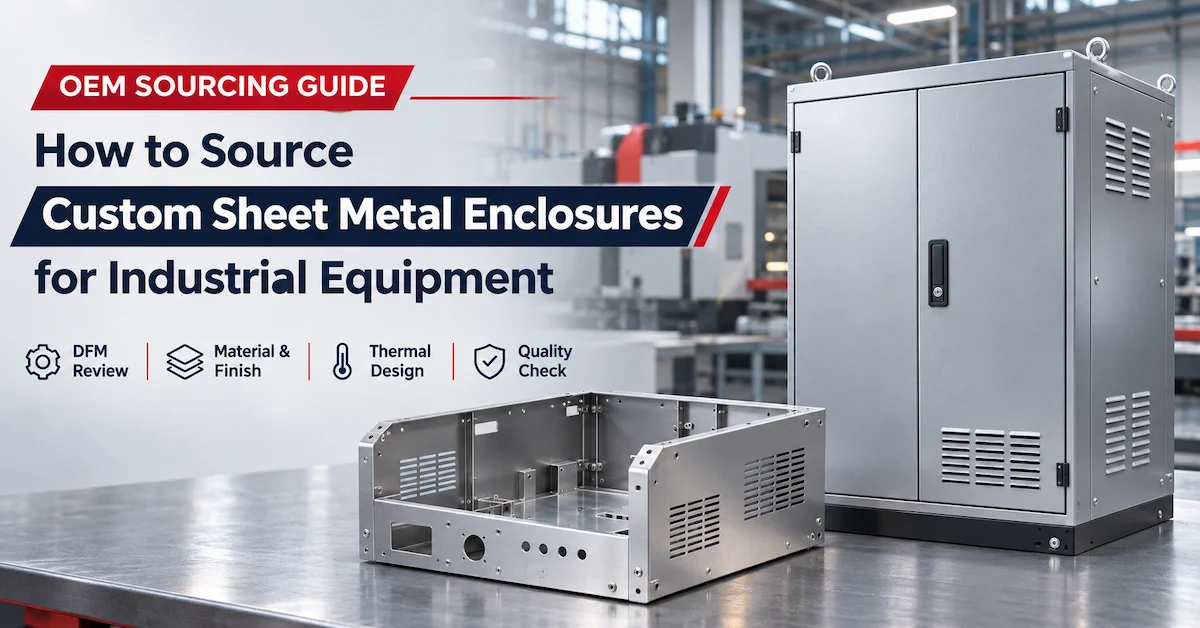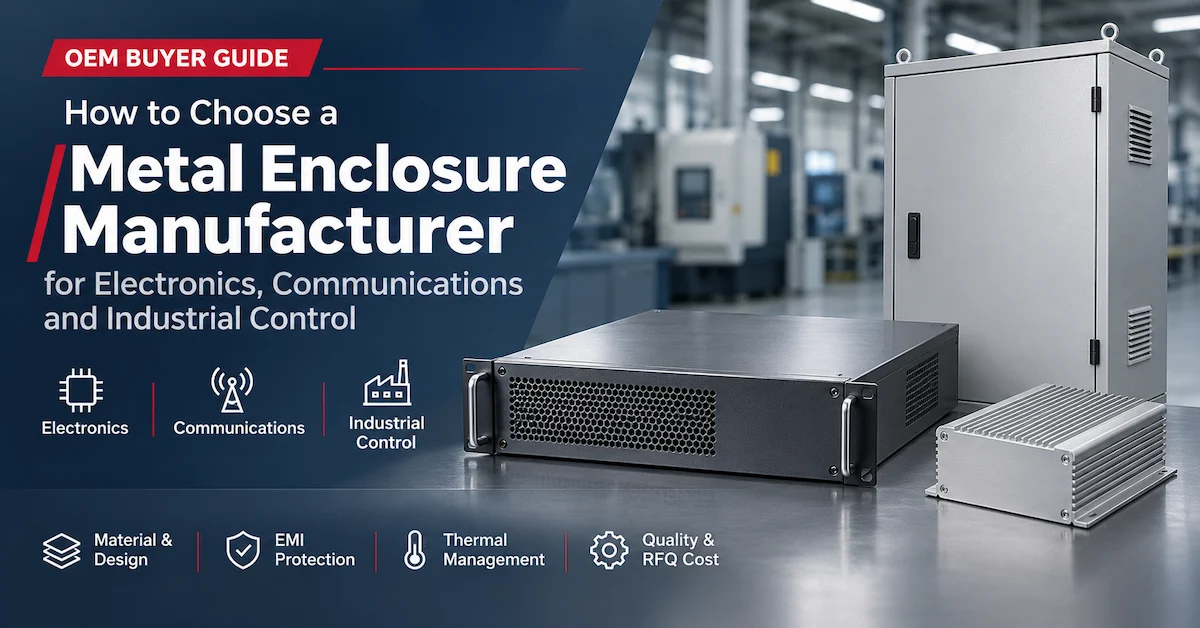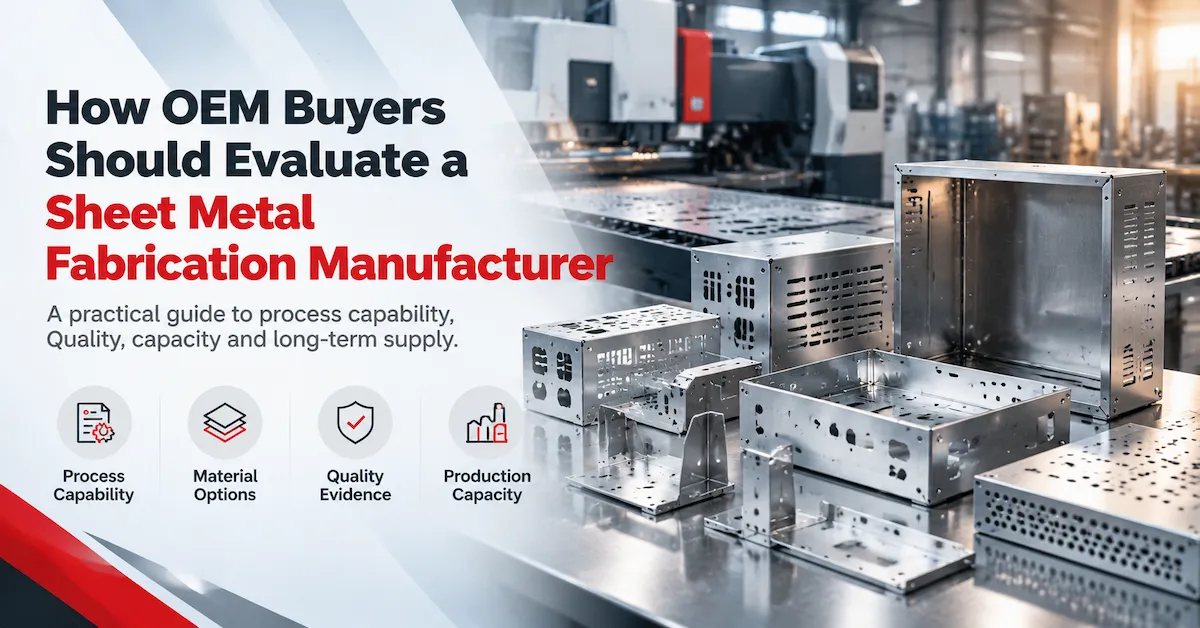
Short answer: choose a custom metal parts manufacturer by proving that one controlled production route can cover the part family from drawing review to repeat shipment. Compare process fit, material traceability, tolerance ownership, tooling, inspection, finishing, assembly, packaging and change control together. The best supplier is not the one with the lowest line-item quote; it is the one that can explain which process will make each feature, what evidence will be supplied, and how the route will remain stable when your prototype becomes a production order.
This guide is for OEM and ODM buyers, R&D engineers and procurement teams preparing an RFQ for mixed metal components. It applies when a project contains an enclosure, bracket, stamped clip, CNC-machined insert, formed panel or other custom component and the team wants fewer supplier handoffs. It deliberately focuses on a quotation and supplier-comparison decision rather than a basic description of metalworking. A custom metal parts manufacturer should make that comparison easier by showing one controlled route for every part number.
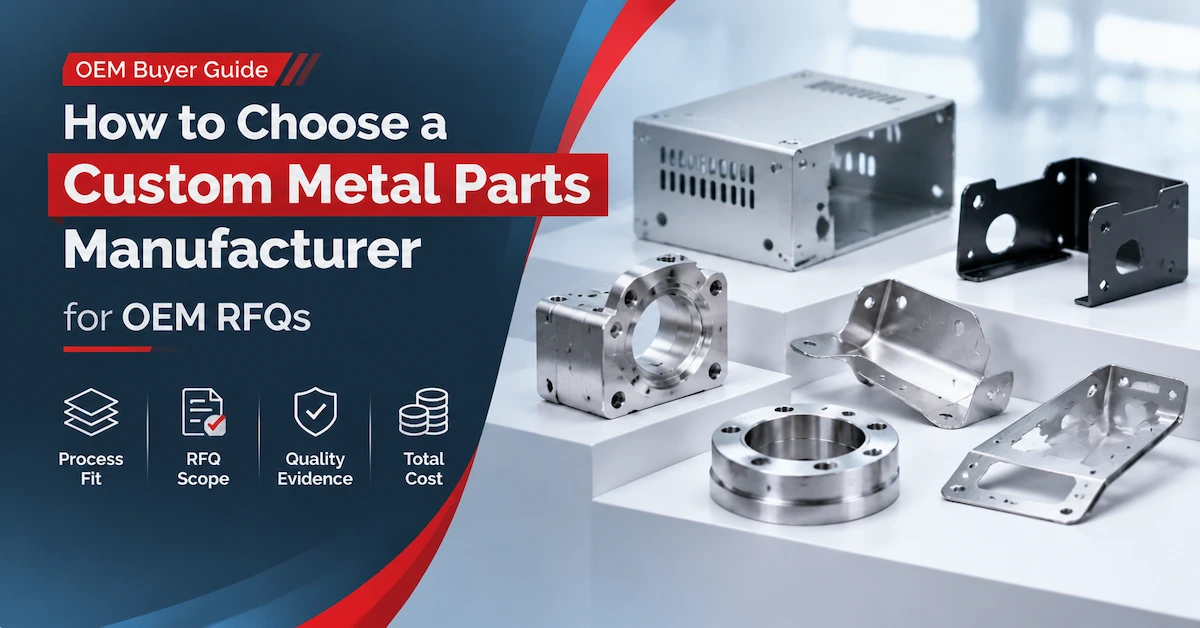
What should a buyer verify first when selecting a custom metal parts manufacturer?
Start with the risk in the part family, not with a machine list. A supplier can own many processes and still be a poor fit if it cannot coordinate datums, finishes, inspection and packaging across them. Send one controlled package to every shortlisted source and require a written answer to the same questions. This makes the comparison useful before price begins to dominate the discussion.
- Process fit: Which operations will make the enclosure, bracket, formed feature, stamped detail or machined interface, and why is that route suitable for the forecast volume?
- Engineering ownership: Who will perform DFM, check bend reliefs and radii, review tool access, and flag conflicts between the 2D drawing and 3D model?
- Quality evidence: Which characteristics will be measured, with which equipment, at what stage, and in what report format?
- Continuity: How will prototypes, pilot lots, repeat orders, engineering changes and approved samples be controlled?
- Commercial scope: Does the quote include tooling, fixtures, secondary operations, inspection, packaging, freight assumptions and technical support?
| Qualification area | Evidence to request | Why it affects the award |
|---|---|---|
| Process route | Operation sequence, proposed process, setup assumptions and secondary operations. | Shows whether the quote represents the actual geometry rather than a generic hourly rate. |
| Material control | Exact grade, temper or condition, incoming checks, mill certificates and lot traceability. | Protects forming behavior, strength, corrosion resistance and downstream fit. |
| Dimensional control | Datum interpretation, critical-feature list, gauges, CMM or projector plan and sample report. | Connects drawing requirements to a repeatable acceptance method. |
| Production continuity | Prototype route, pilot plan, recurring capacity, revision control and backup arrangements. | Separates prototype capability from dependable supply. |
| Commercial scope | Unit price, tooling or fixture cost, MOQ, lead time, finishing, packaging and delivery terms. | Makes competing quotations comparable on total scope. |
When should you use sheet metal, stamping, CNC machining or die casting?
A capable custom metal parts manufacturer should recommend the process from geometry, material, annual quantity, tolerance and assembly requirements. The buyer does not need to prescribe every cutting tool, but the quotation should state why a route is stable and where its cost is created.
Sheet metal fabrication for flexible enclosures and panels
Laser cutting, punching, bending, welding and finishing are often practical for enclosures, covers, brackets and panels when the design may change or volumes are moderate. Sheet metal keeps tooling investment comparatively flexible and can support fast design iterations. The RFQ should define flat-pattern revision, bend direction, minimum flange, weld appearance, corner condition, hole-to-edge rules, masking and the surfaces that must remain cosmetic. For a formed enclosure, also specify whether the buyer needs a loose assembly, welded assembly, hardware insertion or a finished package.
Stamping for repeatable high-volume details
Stamping becomes attractive when a part repeats at scale and the geometry can be organized into a progressive, transfer, compound or forming die. The economic question is not only the piece price. It includes die investment, strip utilization, press availability, maintenance, spare inserts and the cost of changing a feature after approval. Ask for the proposed station logic, carrier strategy, material direction, burr direction and sample inspection plan. A low unit quote without a credible die and maintenance scope is not a low total cost.
CNC machining for tight interfaces and complex solids
CNC milling and turning suit parts with machined datums, deep pockets, threads, bores, angled holes, complex surfaces or low-to-medium quantities. They can be the right route for inserts, tooling plates, sensor mounts, manifolds and precision brackets. The supplier should explain setup count, workholding, probing, tool access, post-machining finishing and how critical relationships will be measured. A drawing with unnecessarily tight general tolerances can make a quote look competitive while transferring cost into inspection and scrap.
Die casting for repeatable near-net-shape housings
Aluminum or zinc die casting can make complex, thin-walled shapes in repeat production when tooling investment is justified. It may reduce machining content, but the design must account for draft, wall transitions, porosity risk, parting lines and secondary machining. If a cast housing later receives CNC datums, inserts or sealing surfaces, the RFQ should show the complete route rather than treating casting as a finished operation.
| Part requirement | Common starting route | Buyer questions before approval |
|---|---|---|
| Low-volume enclosure with changing interfaces | Laser cut and bent sheet metal, with welding or hardware insertion as needed. | What is the flat-pattern revision, bend sequence, finish standard and assembly scope? |
| Recurring clip, terminal or bracket | Progressive or compound stamping after a tool and strip review. | What tool investment, material yield, burr control and maintenance evidence are included? |
| Machined insert or precision mount | CNC milling, turning or mill-turn with controlled setups. | Which datums are functional, how are they held, and what is measured after finishing? |
| Complex housing at repeat volume | Die casting plus trimming, machining and surface treatment. | How are draft, porosity, sealing faces and post-cast machining controlled? |
| Mixed family with shared fit | One coordinated supplier using the best route per part number. | Who owns revision control, assembly fit, packaging and the consolidated quality record? |
How do you select the correct process from volume and geometry?
Do not ask a custom metal parts manufacturer for a process decision using annual quantity alone. Volume is meaningful only when combined with geometry, material behavior, tolerance, number of variants and expected life of the program. A good sourcing review treats the process as a controlled hypothesis and asks the supplier to show the assumptions behind it.
Start with function and interfaces
Mark the surfaces that seal, locate, carry load, conduct electricity, dissipate heat or connect to another assembly. Separate those features from cosmetic surfaces and nonfunctional dimensions. This prevents a supplier from applying an expensive tolerance or finish everywhere when only one interface needs it. For an enclosure, identify connector cutouts, fastener locations, grounding points, gasket lands, thermal paths and access panels.
Check material behavior before choosing the route
Aluminum, stainless steel, carbon steel, copper, brass and coated stock do not behave the same way during bending, stamping, machining or casting. Temper, grain direction, thickness variation and surface condition can change springback, burr formation, tool wear, thermal performance and cosmetic appearance. The RFQ should state the preferred grade and permitted substitutes, and should require approval before substitution. WLD's public capabilities cover aluminum, stainless steel, carbon steel, copper and related production materials across its processes; the part-specific drawing must still control the final grade.
Use tolerance budgets instead of isolated numbers
List the stack-up that determines function. A cover may need a tight hole pattern but a relaxed outside flange. A machined insert may need positional control relative to one datum, not a tight tolerance on every face. A stamped part may need a controlled formed height after springback while its blank outline can use a broader tolerance. Ask the supplier to flag dimensions that require multiple setups, post-finish measurement or a dedicated gauge.
Review quantity by release pattern
Provide prototype quantity, pilot quantity, forecast annual demand, release frequency, peak month and the number of part variants. A five-piece prototype and a recurring release of 5,000 pieces per month may use different workholding, inspection sampling and packaging. If demand is uncertain, request a staged quotation that shows prototype, pilot and production economics instead of forcing one price to cover three very different routes.
What should a custom metal parts RFQ package include?
An RFQ is a manufacturing specification, not just an attachment email. The clearer the package, the less room there is for suppliers to make different assumptions and the easier it becomes to compare quotations. A custom metal parts manufacturer should be able to return this package with a route, exceptions and approval gates instead of a price detached from the drawing.
- Controlled design data: 2D drawing, 3D model, revision, units, GD&T, critical characteristics and approved deviation process.
- Material and finish: grade, temper, thickness, coating, plating, anodizing, powder coating, passivation, roughness, color and cosmetic zones.
- Quantity and timing: prototype, pilot, annual volume, release pattern, target sample date and production ramp.
- Quality deliverables: first-article report, material certificate, dimensional report, functional test, surface report, CoC and traceability expectations.
- Assembly and packaging: hardware, welds, inserts, labels, protective film, separators, carton limits, palletization and export documents.
- Commercial response: unit price by quantity break, tooling or fixture cost, MOQ, lead time, validity, payment, freight basis, exclusions and change-order terms.
Ask each supplier to return a marked-up clarification sheet. It should identify assumptions, exceptions and questions before a purchase order is issued. This step is especially important when a family includes both fabricated and machined parts, because the same “finished part” phrase can mean very different inspection and packaging scopes.
How should buyers compare quotations without choosing the wrong low price?
Normalize quotations into the same cost and risk model. A lower unit price from a custom metal parts manufacturer may exclude tooling maintenance, deburring, post-finish inspection, protective packaging, freight or the engineering work needed to make the part repeatable. A higher quote may include fixtures, reports and change control that prevent later charges.
Separate nonrecurring and recurring cost
Show tooling, fixtures, programming, first-article work and approval samples separately from the recurring piece price. For stamped parts, include die construction and likely wear components. For an enclosure, include forming tools, weld fixtures, hardware and finishing. For CNC parts, include setup and inspection assumptions. This lets procurement compare a prototype award with a production award without mixing unlike costs.
Normalize quantity breaks and MOQ
Require the same quantity points from all suppliers. Ask what drives the MOQ: material purchase, setup, plating lot, die economics or packaging. If the supplier recommends a higher MOQ, ask whether the reason is technical or merely commercial. A rational MOQ should be visible in the quote and should not be confused with the annual forecast.
Price the consequences of change
Ask how an engineering change affects tooling, programming, remaining inventory, inspection records and the next shipment. A supplier with disciplined revision control may appear more formal, but the process protects both sides when a connector moves or a hole pattern changes after pilot approval. Include an agreed deviation and requalification path in the purchase terms.
What quality evidence should a supplier provide?
Quality should be visible in the production route, not presented as a certificate alone. A custom metal parts manufacturer should connect each critical characteristic to an inspection method and a release record. WLD's public quality assurance information describes incoming material inspection, process control and final inspection, along with equipment such as CMMs, projectors, height gauges, contour measurement, a spectrometer, metallographic microscopy and roughness measurement. A buyer should convert that public capability into a part-specific control plan.
- Incoming evidence: material grade, heat or lot identification, certificate review and condition checks.
- In-process evidence: first-piece approval, setup verification, tool or fixture checks, critical dimension records and reaction plans.
- Final evidence: dimensional report, appearance review, functional fit, surface or coating result, quantity reconciliation and release approval.
- Traceability evidence: part revision, lot number, operator or station record where appropriate, subcontracted process record and packing label.
For a mixed part family, ask whether the supplier can keep one revision and lot trail through cutting, forming, machining, finishing, assembly and shipment. The answer matters more than the number of instruments listed on a website. If an outside finisher is used, identify who owns the specification, sampling, nonconformance response and return-to-supplier decision.
Quality control runs throughout the entire production process, from raw material inspection and process control to final inspection before shipment.
That statement is useful only when the RFQ names the characteristics, records and approval gates that make the process auditable for your part.
How can DFM reduce cost without weakening the part?
DFM is the point where a supplier earns the right to influence the design. It should identify a measurable manufacturing risk, explain the effect on cost or repeatability and preserve the function the buyer actually needs. Generic advice such as “increase the radius” is not enough.
For sheet metal and enclosures
Review bend radii, bend relief, hole-to-bend distance, flange width, corner seams, weld access, hardware insertion and finish masking. A small change to a cutout or flange can eliminate a secondary operation or prevent distortion. For an enclosure, also review whether the selected material and finish support grounding, thermal dissipation, corrosion exposure and the planned gasket.
For stamped parts
Review material direction, carrier width, pilot locations, burr side, draw depth, forming radii, springback and scrap evacuation. Ask whether the proposed die can be maintained with replaceable inserts and whether the design permits measurement of the functional features. Tooling recommendations should be recorded before steel is cut.
For CNC parts
Review tool access, internal radii, deep pockets, thin walls, workholding, setup count, datum transfer, threads and post-machining finish. A pocket that is one millimeter deeper may force a longer tool, additional setup or a slower cycle. The right change is the one that protects interface function while removing an avoidable manufacturing burden.
For assemblies and shared families
Review common datums, fastener strategy, interchangeable hardware and the order of assembly. A supplier that makes the enclosure, bracket and insert can identify fit risks earlier, but only if the buyer shares the mating drawings and inspection logic. DFM should result in a revision-controlled decision, not an informal suggestion buried in an email.
What should happen between prototype approval and production?
Prototype approval is not production approval. The route, inspection frequency, packaging and operator instructions often change as volume grows. A reliable supplier defines the transition gates and keeps the approved sample visible to production.
Prototype and design feedback
Use prototypes to validate fit, function, finish and key dimensions, but record which process produced them. A laser-cut prototype should not silently become evidence for a stamped part, and a CNC prototype may not represent a die-cast wall or a formed flange. The supplier should state what is representative, what is temporary and what must be revalidated.
Pilot build and first article
At pilot, confirm the actual material lot, tooling or fixture, process parameters, inspection plan, packaging and label. Review first-article results against the drawing and record any approved deviations. For assemblies, test the fit of mating parts from the same intended production route rather than mixing prototype and production pieces.
Repeat orders and engineering changes
Every release should identify the drawing revision, quantity, requested date and quality documents. When the design changes, define whether old inventory can be used, whether tooling or programs need modification and whether a new first article is required. WLD's public capability pages describe support from prototypes to mass production; the buyer should still make those gates contractual.
How do finishing, assembly and packaging affect the delivered part?
Finishing is part of the specification, not a cosmetic afterthought. Anodizing, powder coating, plating, passivation, polishing, deburring and laser marking can change thickness, conductivity, color, roughness, corrosion behavior and the fit of fasteners or seals. State the functional surface, cosmetic surface, masking zones, color reference, edge condition and acceptable variation.
Assembly requirements should name the hardware, torque or press-fit expectation, orientation, adhesive, weld appearance and functional check. If the supplier ships a kit, define whether parts are mixed by lot, separated by part number or packed as complete assemblies. For metal enclosures, request protection for painted or cosmetic faces, separators for protruding hardware and labels that identify revision and quantity.
Packaging also affects total cost and damage risk. Ask for a packing drawing or sample that shows separators, corrosion protection, protective film, carton limits, pallet configuration and export marks. A quote that is cheap at the factory gate can become expensive after rework, repacking or freight damage. The packaging plan should be approved alongside the first article when the part has cosmetic or sealing surfaces.
Which supplier warning signs should stop an RFQ?
Several warning signs appear before a part is ordered. They are not automatic proof of failure, but they deserve a written response and evidence.
- The supplier quotes from a 3D model without asking for a 2D drawing, revision or acceptance criteria.
- The process recommendation changes with price but the technical assumptions are not explained.
- Material is described only as “aluminum” or “steel” without grade, temper, thickness and permitted substitutes.
- Tooling, fixtures, finishing, inspection reports or packaging are excluded from the price without a clear boundary.
- The supplier promises a delivery date before confirming quantity, material availability, tooling and approval gates.
- Quality is represented by a certificate alone, with no part-specific control plan or sample report.
- Prototype pieces are presented as proof of production readiness even though the production process will be different.
- There is no clear owner for engineering changes, deviations, nonconformance or obsolete inventory.
A professional response does not need to promise every requested result immediately. It should state what is known, what must be reviewed and what evidence will be provided at each gate. That honesty is a better predictor of RFQ performance than a polished capability deck.
Why can a cross-process supplier be useful for metal enclosures and parts?
One coordinated supplier can reduce handoffs when an OEM product combines an enclosure, bracket, stamped hardware and machined interface. The value is not that every part must use the same process. The value is a shared engineering and quality record: common datums, compatible finishes, one revision conversation, consolidated packaging and fewer disputes about where a dimensional error entered the chain.
WLD's product and capability pages expose separate routes for sheet metal parts, stamped parts, CNC parts and custom components. For an enclosure-led program, the relevant commercial destination is the metal enclosures product page. Use those pages to start the conversation, then submit the actual drawings and acceptance requirements for a part-specific review.
For robotics and industrial equipment, this model can simplify brackets, guards, panels, sensor mounts and machined interfaces. For electronics, it can coordinate shielding, grounding, cutouts and hardware. For medical equipment, it can keep cosmetic surfaces, clean handling, traceability and assembly fit visible in one quality plan. The buyer still owns the specification; the supplier earns the award by making the route and evidence explicit.
A final supplier comparison should therefore record the selected process, material, revision, inspection evidence, packaging method and commercial assumptions in one approval record. That record gives engineering, procurement and the custom metal parts manufacturer the same definition of “ready for production.”
What should buyers ask before choosing a custom metal parts manufacturer?
What information should be sent with a custom metal parts RFQ?
Send the controlled 2D drawing, matching 3D model, revision, material and finish, quantities by stage, target dates, critical characteristics, inspection documents, packaging requirements and any approved standards. Include mating drawings when fit matters. Ask the supplier to list assumptions and exclusions in its response.
Can one supplier combine sheet metal, stamping and CNC parts?
Yes, when the supplier has the relevant process control and can keep one revision, quality and packaging system across the part family. The buyer should still request a route for each part number and confirm which operations are in-house, coordinated through partners or subcontracted.
How do I compare a prototype quote with a production quote?
Separate prototype setup, programming, fixtures and inspection from recurring piece price. Then compare pilot and production quantity breaks using the same finish, quality documents, packaging and delivery assumptions. A prototype route may be intentionally different from the production route, so ask what must be revalidated.
What material documents should a supplier provide?
At minimum, define the material grade, temper or condition, thickness, lot identification and certificate requirement. If a substitute is proposed, require written approval and a statement of how strength, forming, corrosion, conductivity or appearance will be affected.
How should tolerances be handled in a mixed-process project?
Identify functional datums and build a tolerance stack around interfaces. Use general tolerances for noncritical features and tighter values where function requires them. Ask the supplier to identify dimensions that need multiple setups, post-finish inspection, gauges or a process change.
What quality reports are useful for OEM approval?
Useful deliverables can include a first-article dimensional report, material certificate, functional or fit check, surface or coating result, nonconformance record and packing traceability. The exact set should match the risk of the part rather than being copied from an unrelated program.
What MOQ and lead time should I expect?
MOQ and lead time depend on material purchase, tooling, setup, finishing lot, inspection scope, packaging and the release pattern. Do not accept an unqualified number. Provide the quantity and target date, then ask the supplier to state assumptions, approval gates and what could change the commitment.
How can I protect an enclosure during shipment?
Define cosmetic faces, sealing surfaces, protective film, separators, corrosion protection, hardware orientation, carton limits, palletization and labels. Approve the packing method with a sample or packing drawing when the part can scratch, dent, deform or lose fit in transit.
When should I request DFM before asking for a final price?
Request DFM before tooling, fixture or production approval, and ask the supplier to identify any price or schedule consequence. A DFM review is most valuable when it is tied to a marked-up drawing, a proposed process and a decision that the buyer can approve or reject.
What makes a supplier response credible?
A credible response connects the drawing to a process, the process to inspection, and inspection to shipment. It names material and finish assumptions, separates nonrecurring and recurring cost, identifies exclusions and sets clear approval gates. Capability claims become useful when they are converted into evidence for your specific part family.
Conclusion
Choosing a custom metal parts manufacturer is a route-and-evidence decision. Compare sheet metal, stamping, CNC machining and die casting from the functional features, volume, material, tolerance and finish, then normalize tooling, fixtures, inspection, packaging, MOQ and lead time before comparing unit prices. Require a clear RFQ response, practical DFM, traceable quality records and a defined prototype-to-production handoff. For OEM and ODM teams sourcing metal enclosures, brackets, stamped details and machined interfaces, a coordinated supplier can reduce handoffs while keeping the specification under buyer control. That is the practical standard for selecting a custom metal parts manufacturer for a production program.
WLD Technology can review a drawing package for metal enclosures and related custom components, identify a suitable process route and return the assumptions that affect price, quality and delivery. Include the part files, quantity by phase, material, finish, critical dimensions and target date so the technical review can be specific.