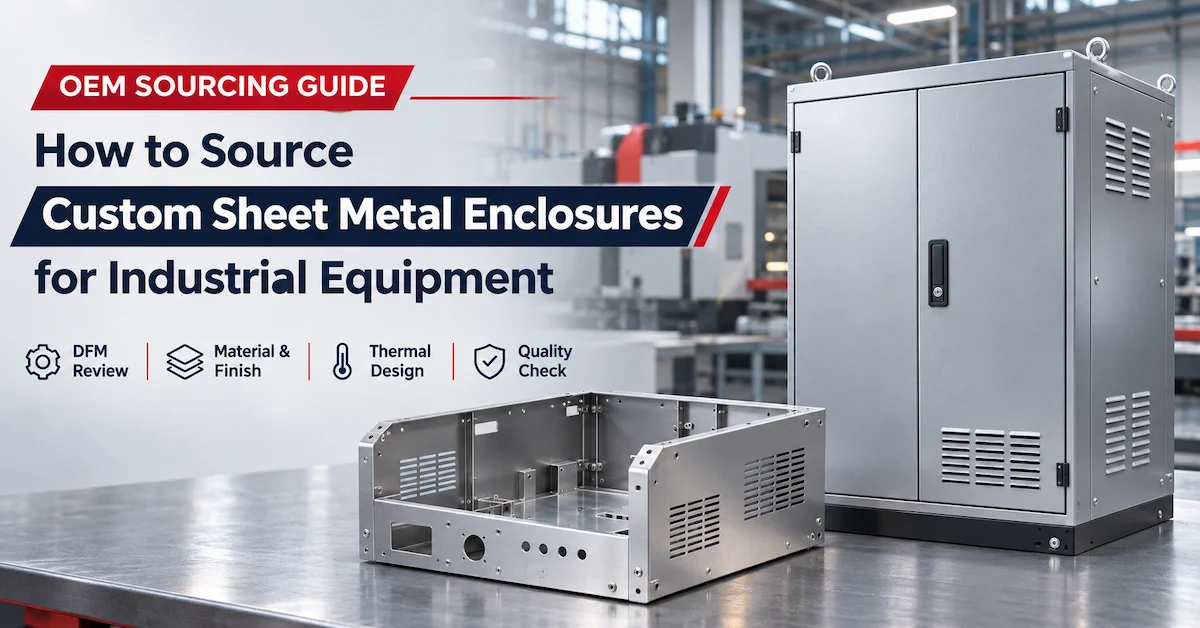
Short answer: source custom sheet metal enclosures for industrial equipment by qualifying the complete route from equipment interfaces to inspected, packed production units. The supplier should review the enclosure's load path, doors and panels, cable entries, grounding, thermal behavior, surface finish, assembly and service access before quoting. For an industrial OEM, the right supplier is the one that turns those requirements into a controlled DFM record, a repeatable fabrication process and evidence that the finished enclosure will fit the machine it protects.
This guide is written for industrial equipment OEMs, mechanical engineers, controls engineers and procurement teams preparing a project RFQ. It focuses on enclosure decisions that are often missed when buyers compare only a flat-pattern price: datum selection after bending, panel stiffness, hinge and latch loading, cable-bend clearance, heat dissipation, grounding, powder-coat masking, inspection scope, packaging and the transition from prototype to repeat production. When a project calls for custom sheet metal enclosures for industrial equipment, these decisions should be recorded before supplier selection.
WLD Technology is a Shenzhen, China manufacturer founded in 2003, supporting global OEM delivery. Its public capabilities include sheet metal fabrication, metal stamping, tooling and die manufacturing, CNC machining and quality inspection. These company-level capabilities are a starting point. Your RFQ should still define the exact enclosure revision, material, finish, quantity, acceptance records, MOQ and delivery assumptions for the project.
What should an RFQ for custom sheet metal enclosures for industrial equipment include?
An industrial equipment enclosure usually carries more responsibility than a cosmetic cover. It may support a door, fan, HMI, cable gland, terminal rail, drive, filter, sensor, lifting point or service panel. It must fit the machine frame, protect internal hardware and remain serviceable after repeated access. That means the RFQ for custom sheet metal enclosures for industrial equipment needs both product requirements and manufacturing evidence.
- Equipment interface: show the frame, mounting feet, panels, mating covers and the space reserved for installation and maintenance.
- Environmental duty: define indoor or outdoor exposure, dust, moisture, oil, vibration, temperature, cleaning method and corrosion expectations.
- Functional surfaces: identify gasket lands, grounding points, heat-transfer pads, connector cutouts, latch areas and mounting datums.
- Production stage: state whether the project is a prototype, pilot build, low-volume release or recurring equipment program.
- Quality evidence: list the dimensional, appearance, material, finish, assembly and packaging records needed for acceptance.
| RFQ area | Information to provide | Why procurement should care |
|---|---|---|
| Equipment envelope | Machine interface, mounting pattern, door swing, service clearance and internal layout. | Prevents a box that meets its own drawing but cannot install or be serviced. |
| Process and DFM | 2D drawing, 3D model, material, thickness, bend data, welds, hardware and finish. | Allows suppliers to quote the same manufacturing assumptions. |
| Critical quality | Datums, hole position, flatness, angle, gasket land, grounding and cosmetic zones. | Connects functional requirements to measurable acceptance criteria. |
| Commercial scope | Quantity by phase, tooling or fixture, assembly, inspection, packaging, delivery and MOQ. | Exposes total cost instead of hiding work outside the unit price. |
| Change control | Revision rules, deviation approval, sample retention and requalification triggers. | Protects the OEM when the machine design changes during ramp-up. |
Which enclosure architecture fits the machine?
The architecture should follow the equipment's load path and service method. A small operator interface, a floor-standing controls cabinet and a mobile industrial module may all be made from sheet metal, but they do not share the same stiffness, access or protection requirements. This is why custom sheet metal enclosures for industrial equipment should be reviewed with the complete machine assembly in view.
Floor-standing control cabinets
Floor-standing cabinets need a stable base, stiff side panels, door alignment and a repeatable mounting relationship to the machine frame. Review base plates, leveling feet, lifting or handling points, door hinges, latch compression and the distribution of internal loads. Large flat panels may need folds, returns, ribs or internal supports to prevent oil-canning and to keep doors aligned. Ask the supplier how those features will be formed and checked.
Operator panels and HMI housings
Operator panels combine visible surfaces, displays, pushbuttons, emergency-stop devices, cable entries and mounting hardware. The drawing should identify the viewing face, cutout positions, edge radii, gasket land, panel thickness and the direction of installation. A minor shift in a control cutout can interfere with the HMI bezel or create an unsafe access condition, so hole position and flatness should be treated as functional characteristics.
Machine guards and access covers
Guards and covers protect operators and equipment while allowing inspection and maintenance. Define access frequency, hinge or removable-panel strategy, fastener location, edge condition and the relationship to moving components. If a guard must carry a switch, interlock or sensor, include the mounting and cable-routing requirements. The supplier should review whether a bend, weld or fastener can distort the safety-critical interface.
Electrical and thermal equipment housings
Housings for drives, power supplies and control modules need internal spacing, ventilation or heat-transfer paths, grounding and cable management. Mark heat sources, fan openings, filters, conductive contact points and the surfaces that must remain bare after coating. A supplier should identify how flatness, thermal pads and grounding studs will be checked after fabrication and finishing.
How should DFM be completed before the quotation?
DFM should be a short, traceable engineering document that connects each recommendation to a drawing feature, risk and decision. It should not be a generic list of bend rules sent after the purchase order. Ask the supplier to return a marked-up drawing or table before approving the final quote for custom sheet metal enclosures for industrial equipment.
Review flat-pattern logic and bend sequence
Confirm bend direction, inside radius, bend allowance, relief, flange width and the sequence needed to reach every feature. A large flange may block a tool, a hole close to a bend may distort, and a narrow return may be difficult to inspect. The DFM response should identify which dimensions are controlled in the flat pattern and which are controlled after forming.
Choose datums that exist on the finished enclosure
Industrial equipment interfaces are usually checked after cutting, bending, welding and finishing, not on the flat blank. Define a primary datum that can be held on the assembled or formed enclosure, then identify the secondary datums that locate doors, mounting holes, panels and gasket lands. A drawing that references only a flat-pattern origin may be difficult to reproduce and even harder to inspect.
Control large panels, returns and weld distortion
Large panels can bow during cutting, bending, welding or coating. Use returns, beads, ribs, internal brackets or a planned weld sequence when stiffness and appearance require them. The DFM review should state whether a flatness or profile requirement is functional, cosmetic or both. If a panel receives a gasket, display or EMI contact, the inspection plan must identify the relevant area rather than applying a vague “flat” note.
Plan cable entries, service access and hardware
Check cable bend radius, gland clearance, connector insertion, tool access and the route for replacing filters or drives. Specify press nuts, studs, standoffs, hinges, latches and grounding hardware by type and location. Hardware insertion can change local flatness and may require a fixture or a defined pull-out or torque check. These details should be resolved before the supplier prices a production enclosure.
Define the finish without hiding functional surfaces
Powder coating, plating, anodizing, passivation and other finishes alter thickness, conductivity, color, roughness and fit. Mark masking zones for grounding, gaskets, threads and heat-transfer surfaces. State the color reference, gloss, texture, cosmetic faces and acceptable variation. “Painted black” is not enough to compare two enclosure quotations or to release a first article.
Which materials work for industrial equipment enclosures?
Material choice should reflect stiffness, weight, corrosion, heat, conductivity, forming behavior and the installation environment. A custom sheet metal enclosure supplier should state the exact grade and thickness, not only the family name.
Carbon steel and galvanized sheet
Carbon steel can provide stiffness and economical fabrication for cabinets, guards and equipment panels. Galvanized sheet can add corrosion protection, but the coating affects welding, edge treatment and finishing. Specify the coating condition, weld preparation, pretreatment, edge protection and whether all cut edges must receive additional protection.
Stainless steel
Stainless steel may suit washdown, corrosion exposure or cleanable equipment. Its work-hardening, springback, heat tint and visible weld condition affect both process and appearance. Define grade, thickness, grain direction when cosmetic, weld finish, passivation and the acceptable surface standard. Ask how the supplier will protect the surface during bending and assembly.
Aluminum
Aluminum can reduce weight and support a thermal path for drives, power supplies or control modules. It also requires attention to bend radius, springback, thread strength, grounding and the effect of anodizing or powder coating on contact surfaces. State alloy or permitted family, temper, thickness, finish and the locations where bare metal is required.
Copper and conductive hardware
Copper or copper alloys are often used for busbars, grounding straps and conductive clips inside or alongside the enclosure. If these parts mate with a coated panel, define plating, burr control, contact resistance and assembly order. The enclosure RFQ should show how the conductive feature is supported and protected, even when it is quoted as a separate part.
| Application requirement | Material and design questions | Evidence at approval |
|---|---|---|
| Stiffness and panel stability | What spans, loads, doors or equipment are supported? | Flatness, profile, fixture or assembly-fit record. |
| Corrosion or washdown | What grade, pretreatment, finish and edge protection are required? | Material certificate, finish record and approved visual standard. |
| Thermal transfer | Which surfaces contact heat sources and must remain flat or conductive? | Interface measurement, masking check and assembly verification. |
| Grounding and EMI | Where are grounding studs, conductive seams, gaskets and bare-metal contacts? | Continuity or contact check and documented contact-surface inspection. |
| Weight and handling | What is the lifting, installation and service limit for the assembled enclosure? | Hardware, hinge, latch and packaging checks before shipment. |
How should the fabrication route be compared?
Do not compare only “laser cut and bent” against “fabricated.” Ask each supplier to describe the route from incoming sheet to packed enclosure and to identify where a fixture, secondary operation or outside process is required.
Cutting and hole patterns
Laser cutting is flexible for complex profiles and prototypes, while turret punching can be efficient for repeat patterns and formed features. Review small holes, burr direction, heat-affected edges, nested yield, hole-to-edge distance and the surfaces that will remain visible. If a hole receives a press-fit hardware item, the quote should include its size control and inspection.
Bending and forming
Press-brake bending determines the enclosure's final geometry. Review tool access, bend order, springback compensation, flange width, inside radius and the datum used after forming. A supplier should identify whether the design needs special tooling, a checking fixture or a first-article angle and position report.
Welding and mechanical joining
Welding can add stiffness and seal a shell, but heat input and sequence can distort panels. Define weld symbols, joint condition, visible weld standard, leak or strength requirement, spatter control and post-weld finishing. Bolted or hardware-based joining may improve serviceability, but requires accurate hole position, thread control and torque or pull-out requirements.
Machining and secondary operations
CNC machining may be needed for a heat-transfer pad, precision mounting face, connector interface or threaded feature. Deburring, grinding, brushing, passivation, powder coating, anodizing and plating can change dimensions and surface condition. The quote should identify the order of operations and the point at which critical dimensions are measured.
Assembly and inspection fixtures
Fixtures are often the difference between a prototype that fits and a production enclosure that repeats. Ask whether the supplier will use a bend checking fixture, weld fixture, assembly fixture or go/no-go gauge. Clarify fixture ownership, maintenance, storage and change control. The fixture should be tied to the drawing revision and the features it controls.
What quality evidence should an OEM request?
Quality evidence should make the enclosure's acceptance criteria visible. WLD's public quality assurance information describes incoming material inspection, process control and final inspection, supported by equipment such as CMMs, projectors, height gauges, contour measurement, spectrometer analysis, metallographic microscopy and roughness measurement. For an industrial enclosure RFQ, translate that public capability into a part-specific plan for custom sheet metal enclosures for industrial equipment.
- Incoming material: grade, thickness, lot identification, certificate review and condition checks.
- In-process control: first-piece approval, bend angle and position, hardware insertion, weld inspection, fixture verification and reaction plan.
- Finish control: color, gloss, texture, coating or plating record, masking and cosmetic inspection.
- Final dimensional control: mounting pattern, door or panel fit, flatness, hole position, angle, gasket land and critical interfaces.
- Release and traceability: revision, lot, nonconformance disposition, certificate of conformity, packing label and shipment record.
Quality control runs throughout the entire production process, from raw material inspection and process control to final inspection before shipment.
For procurement, this means the supplier should name the characteristics, records and approval gates rather than simply provide a certificate. If powder coating, plating or another operation is outsourced, define who owns the specification and the response to a nonconforming lot.
How should industrial equipment enclosure quotations be normalized?
A quotation is comparable only when each supplier has priced the same finished condition. Separate nonrecurring engineering from recurring piece price and record every assumption that affects delivery or acceptance.
- Nonrecurring scope: DFM, programming, bend tools, weld fixtures, checking fixtures, prototypes and first-article work.
- Recurring scope: material, cutting, forming, welding, hardware, machining, finishing, assembly, inspection and packing.
- Commercial assumptions: quantity breaks, MOQ, material purchase, outside processing, freight basis, payment and quote validity.
- Approval gates: drawing release, DFM approval, prototype, pilot, first article, finish approval and production release.
- Change exposure: tooling modification, obsolete inventory, requalification and the disposition of nonconforming or superseded parts.
Ask suppliers to return a written assumption sheet with the price. If one supplier assumes customer-supplied material, another includes powder coating and a third excludes the inspection report, their unit prices cannot be compared honestly. A procurement scorecard should show cost, quality evidence, engineering response, capacity, risk and delivery rather than price alone.
How should MOQ and lead time be evaluated?
MOQ may be driven by sheet purchase, setup time, finishing lots, assembly labor or packaging. Lead time may include material confirmation, DFM, fixture construction, first article, outside finishing and shipment. Provide prototype, pilot and recurring quantities and ask the supplier to state what starts the clock. Do not accept an unqualified calendar promise.
How should fixture ownership be handled?
State whether the fixture is customer-owned, supplier-owned or shared, where it is stored and who maintains it. Tie its design to the drawing revision and list the features it controls. If the enclosure changes, define whether the fixture can be modified and whether a new first article is required.
What should happen from prototype to repeat production?
Prototype approval proves that the concept can be assembled; it does not prove that the production route will repeat. An industrial equipment OEM should define transition gates and identify which prototype operations are temporary.
Prototype review
Check machine fit, door or cover operation, cable access, HMI and connector position, grounding concept, heat path, finish and service clearance. Record material and process differences between the prototype and intended production enclosure. A laser-cut prototype should not be treated as proof of a welded, coated production cabinet.
Pilot build
At pilot, confirm the production material lot, tools, fixtures, bend sequence, weld settings, hardware and finish. Use production-intent mating components and complete the agreed dimensional and assembly checks. Record deviations and assign an owner before the production release.
Repeat orders and engineering changes
Each release should identify drawing revision, quantity, requested date, packaging and required quality documents. When a cutout, hinge, panel or gasket changes, define whether programming, fixtures, inventory and first-article approval must change. WLD publicly describes support from design optimization and prototyping through trial production, mass production and logistics; the RFQ should convert those stages into approval gates.
How do finishing, assembly and packaging affect the enclosure?
Finishing is a functional specification. Powder coating, anodizing, plating, passivation and polishing can change thickness, conductivity, corrosion behavior, color, roughness and fit. Mark grounding points, gasket lands, threads, heat-transfer pads and other surfaces that must remain bare or controlled. Define color, gloss, texture, masking, edge condition and cosmetic zones using an approved sample or clear standard.
Assembly requirements should name hinges, latches, press nuts, studs, standoffs, gaskets, conductive fingers, labels, torque and functional checks. If the supplier ships a kit rather than a complete cabinet, specify part separation, lot identification and hardware packaging. For industrial equipment, the order of assembly can affect door alignment, cable access and the ability to service the installed electronics.
Packaging must protect long flanges, painted faces, doors, windows, grounding points and protruding hardware. Request protective film, separators, corrosion protection, carton limits, pallet configuration and export marks. Approve the packing method with the first article when the enclosure is large, cosmetic or vulnerable to deformation. Shipment damage is a quality and procurement issue, not merely a logistics issue.
Which warning signs should stop an enclosure supplier award?
Several warning signs appear before a production order. They require evidence or a documented corrective response before the supplier is approved.
- The quote is based on a photograph or 3D model without a controlled 2D drawing and revision.
- The supplier cannot explain datums after bending, welding or finishing.
- Material is listed only as “steel” or “aluminum” without grade, thickness and permitted substitutes.
- DFM comments arrive after tooling or fabrication has already started.
- EMI, grounding, thermal, gasket or service-access features are treated as informal notes.
- Fixtures, finishing, assembly, inspection reports or packaging are excluded without a clear boundary.
- Lead time is promised before material, DFM, fixture, first article and finish approval are confirmed.
- Quality is represented by an ISO certificate alone, with no part-specific control plan or sample report.
- There is no owner for revisions, deviations, nonconformance, obsolete inventory or returned parts.
A credible supplier can state what is known, what needs review and what evidence will be supplied at each gate. That response is more valuable than a low number detached from the machine, the enclosure and the quality record.
What should industrial equipment buyers ask before ordering?
What should be included in a custom sheet metal enclosure RFQ?
Include the 2D drawing, matching 3D model, revision, material, thickness, finish, equipment interfaces, mounting pattern, door and panel details, cable entries, grounding and thermal requirements, quantities by stage, target dates, inspection records, assembly scope and packaging requirements. Include mating components when fit depends on them.
How do I choose between welded and hardware-assembled panels?
Choose from service access, stiffness, sealing, appearance, production volume and change frequency. Welding can add rigidity or seal a shell but may introduce heat distortion. Hardware assembly can simplify service or changeover but requires accurate holes, thread control and torque checks. Ask for a route comparison tied to the actual enclosure.
How should I specify grounding and EMI features?
Identify the shield boundary, conductive seams, grounding studs, gasket or finger locations, masking zones and the required continuity or contact evidence. State how the coated enclosure will maintain the electrical path. Do not rely on a visual inspection alone when the feature controls equipment performance.
What quality reports should be requested for a first article?
A first-article package may include material certificates, dimensional results, flatness and angle checks, hole and mounting-pattern measurements, hardware and assembly checks, finish records, appearance approval, grounding or continuity evidence, certificate of conformity and packing traceability. The exact package should match the enclosure's risk.
How can DFM reduce the cost of custom sheet metal enclosures for industrial equipment?
DFM can reduce cost by removing unnecessary tight tolerances, reducing setups, improving bend access, simplifying hardware, avoiding secondary machining, selecting a practical material and designing fixtures that repeat. The supplier should show the affected feature, functional reason, cost or schedule effect and required approval.
What MOQ and lead time should be expected?
MOQ and lead time depend on material purchase, fixtures, setup, finishing lot, inspection, assembly, packaging and release pattern. Give the supplier prototype, pilot and recurring quantities and ask for assumptions and approval gates. A project-specific commitment is more useful than a generic number.
How should powder coating be controlled?
Specify color, gloss, texture, pretreatment, coating thickness, masking, bare-metal contacts, cosmetic zones and the approved sample. Identify threads, gasket lands, grounding points and heat-transfer pads that must remain functional after finishing.
How can a large enclosure be protected during shipment?
Use protective film, edge protection, separators, corrosion control, hardware bags, door restraints, carton limits and palletization matched to the enclosure. Approve the packing drawing or sample when painted faces, windows, flanges or doors can be damaged or deformed.
When should a buyer require a new first article?
Require reapproval when a critical drawing revision, material, finish, fixture, process route or supplier-controlled sub-process changes. The purchase terms should state which changes trigger a new dimensional, assembly, finish or functional review.
What makes a supplier reliable for custom sheet metal enclosures for industrial equipment?
A reliable supplier connects the equipment interface to a DFM decision, the DFM decision to a stable fabrication route, the route to inspection and the inspected enclosure to protected shipment. It names assumptions, owners, records and approval gates instead of relying on a generic capability statement.
Conclusion
Sourcing custom sheet metal enclosures for industrial equipment requires more than comparing a bent-box unit price. Define the machine interface, load path, service access, material, finish, grounding, thermal path, cable entry, inspection evidence, packaging and change-control rules. Ask suppliers to return a drawing-specific DFM response, a complete fabrication route and a normalized quotation that separates fixtures, recurring production, quality records and delivery assumptions. For an industrial equipment OEM, the best supplier is the one that can repeat the enclosure and prove why the approved unit fits, functions and arrives protected.
WLD Technology can review an industrial equipment enclosure package and connect DFM, fabrication and quality requirements to a project-specific quotation. Include the CAD files, application, quantity by phase, material, finish, critical dimensions, required inspection records and target date so the technical response addresses the real procurement decision. For a direct technical conversation, use the WLD contact page with the drawing package.