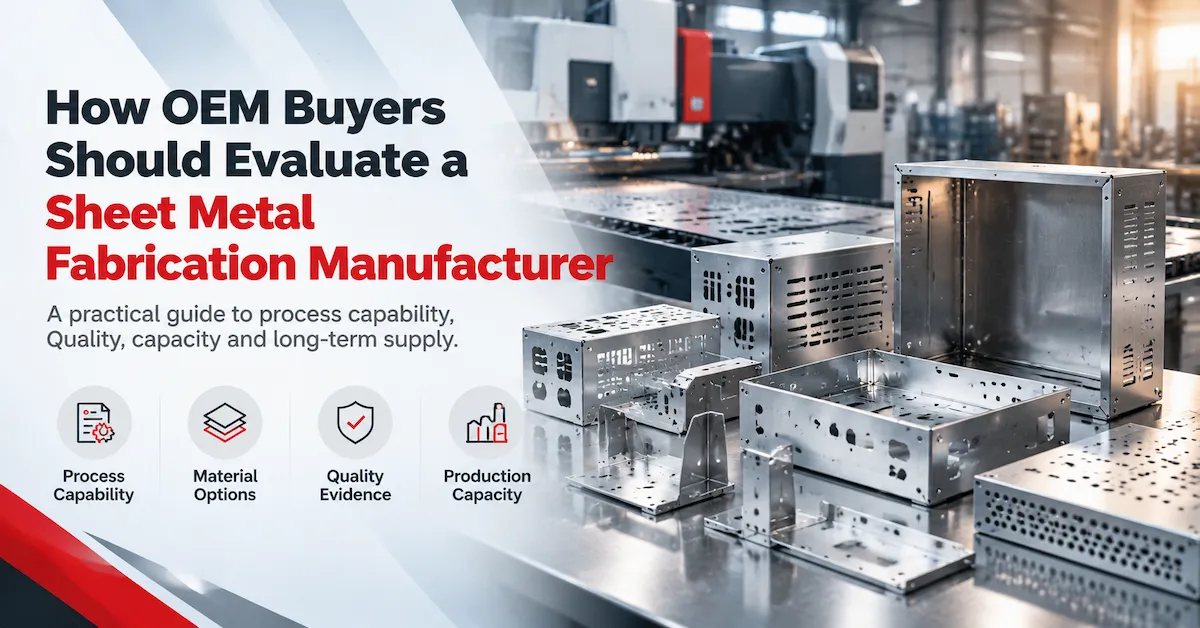
How OEM Buyers Should Evaluate a Sheet Metal Fabrication Manufacturer
Short answer: choose a sheet metal fabrication manufacturer by proving process fit, material control, engineering support, inspection capability, production scale and communication before comparing price. A supplier that can cut a prototype is not automatically ready for repeat production. Your evaluation should connect the drawing, material, tolerances, assembly requirements, quality records, packaging and delivery plan into one traceable manufacturing path.
For OEM buyers, the most useful supplier comparison is therefore not a list of machines or a low first quotation. It is a documented answer to one question: can this manufacturer repeatedly deliver the specified part, at the required volume, with acceptable risk? This article provides a practical assessment framework for a sheet metal fabrication manufacturer serving prototypes, low-volume programs and recurring production.
The framework is written for procurement managers, product engineers, mechanical designers and quality teams sourcing custom metal parts for industrial equipment, new energy, electronics, medical devices, automation and related B2B applications. It also explains what information to include in an RFQ so the supplier can respond with a useful quotation rather than a vague price range.
A buyer searching for a sheet metal fabrication supplier is usually trying to solve this same qualification problem. The request becomes more specific for a precision sheet metal fabrication supplier for OEM production or a custom sheet metal parts supplier for OEM production, but the decision still depends on evidence: a defined process, controlled materials, measurable quality and a production plan tied to the drawing.
What a sheet metal fabrication manufacturer must prove
A credible sheet metal fabrication manufacturer should be able to connect five evidence areas:
- Technical fit: the factory has the cutting, forming, joining and finishing processes required by the part.
- Material fit: the proposed stainless steel, aluminum alloy, carbon steel or galvanized steel matches the environment and functional requirement.
- Quality fit: inspection plans, measurement equipment and corrective actions can control the dimensions that affect function and assembly.
- Commercial fit: prototype, trial production, repeat orders, packaging and international delivery can be coordinated without hidden handoffs.
- Communication fit: engineering questions, drawing revisions, approvals and nonconformities have named owners and a clear record.
These areas are related. A tight bend tolerance is not only a press-brake question. It also depends on material thickness, grain direction, bend sequence, tooling, spring-back compensation, inspection method and the datum scheme on the drawing. A good supplier explains those dependencies before production instead of discovering them after parts are made.
1. Start with the part and the production stage
Before contacting a manufacturer, classify the project. A prototype enclosure, a one-time machine guard and a recurring electrical cabinet may all use sheet metal, but they need different supplier behaviors. Identify whether you need design refinement, a rapid prototype, a small-batch trial, a production tool, or a stable recurring order. This gives the supplier the context needed to recommend a process and a realistic quotation basis.
Prototype and design validation
At prototype stage, speed and learning matter. You may accept a process that is not yet optimized for maximum throughput if it produces representative geometry and allows the engineering team to validate fit, access, thermal behavior, assembly and appearance. Ask whether the supplier can review an incomplete drawing, identify manufacturing risks and suggest a production-ready revision. Confirm which dimensions are functional and which can be relaxed for the prototype.
Trial production and NPI
During trial production, the question changes from “can the part be made?” to “can the process be repeated?” The supplier should explain the approved material, process sequence, first-piece approval, inspection records, packaging and change-control method. If welding or assembly is involved, define the fixture, joint condition, distortion risk and visual acceptance criteria before the first batch.
Recurring production
For recurring orders, evaluate capacity and continuity. Ask how the supplier manages high-mix/low-volume work alongside repeat production, how revisions are controlled, and how approved samples or inspection standards are retained. The goal is not merely a first shipment. It is consistent output across purchase orders and across the life of the product.
2. Verify process fit instead of counting machines
A machine list has value only when it explains how your part will be made. Request a process route that starts with the material and ends with an inspected, packed assembly. The route should identify operations, critical dimensions, likely risks and the inspection point for each risk.
Cutting and blank preparation
Fiber laser cutting and CNC turret punching can produce different edge conditions, hole strategies and economic results. Laser cutting is useful for complex contours and flexible prototype work. Punching can be efficient for repeated patterns and selected high-volume geometries. The decision should consider material, thickness, hole-to-edge distance, burr requirements, heat-affected zones, quantity and downstream forming.
Ask the manufacturer how it controls small holes, narrow webs, burr direction and heat distortion. If the part will be powder coated, assembled against a gasket or used as an electrical enclosure, edge condition may affect both function and appearance. A quote should identify whether deburring, brushing or edge treatment is included.
Bending and forming
Multi-axis CNC press brakes can handle complex bend sequences, but capability is not the same as guaranteed accuracy. Review the bend radius, flange length, material spring-back, tooling access and bend order. Confirm how the supplier establishes the primary datum and how it checks the angles and positional dimensions that control assembly.
For a formed enclosure, the visible result can be affected by bend marks, corner relief, minimum flange length and the relationship between holes and bend lines. A practical supplier raises these issues during DFM rather than after the first article fails to fit.
Welding and assembly
TIG, MIG and spot welding serve different joint and appearance requirements. Ask whether the design needs full penetration, intermittent welds, controlled heat input, sealed joints, cosmetic grinding or a fixture. For frames and cabinets, distortion can change door gaps, flatness and mounting alignment. The inspection plan should specify which dimensions are checked after welding and whether a functional assembly test is required.
Surface finishing
Powder coating, anodizing, plating and polishing are not interchangeable. The correct choice depends on corrosion exposure, electrical isolation, wear, appearance, conductivity, masking and the expected service environment. Confirm color reference, gloss, coating thickness, pretreatment, masked areas and acceptance standard. If finishing is performed by a partner, ask how the supplier controls transport, traceability and final inspection.
3. Match materials to function and risk
Material selection should be driven by function, environment and production economics, not by a generic preference for the lowest price. A supplier should help you compare corrosion resistance, weight, strength, thermal behavior, conductivity, formability, finish and availability.
| Material family | Typical reason to consider it | Questions for the RFQ |
|---|---|---|
| Stainless steel | Corrosion resistance, cleanability and demanding indoor, outdoor or process environments. | Which grade, thickness, surface finish, grain direction and cosmetic standard are required? |
| Aluminum alloys | Lower weight, useful corrosion behavior and suitability for electronics or new-energy structures. | Which alloy and temper, what forming limits, and is anodizing or another finish required? |
| Carbon steel | Cost-effective structural parts, frames, brackets and industrial equipment. | What strength, weld condition, coating system and corrosion exposure must be controlled? |
| Galvanized steel | Corrosion protection built into the sheet for selected equipment and enclosure applications. | How will the coating be protected during forming, welding and finishing? |
Material evidence matters. Ask for the material designation, thickness tolerance, surface condition and any required mill certificate or material test report. WLD’s public quality information identifies incoming material inspection and a handheld spectrometer among its quality resources. That does not replace your project specification, but it provides a useful starting point for discussing material verification.
Do not ask a supplier to “use the closest material.” If the drawing is unclear, record the open point and resolve it before release. Material substitutions can affect bend behavior, weldability, corrosion performance, coating adhesion and final weight.
4. Use DFM support to reduce cost and late changes
DFM is valuable when it produces a decision, not when it is used as a general marketing phrase. Ask the manufacturer to identify the features that drive cost, delay or quality risk. The review should be connected to your drawing and should explain the trade-off behind each proposed change.
High-value DFM questions
- Can the bend sequence be simplified without changing the assembly interface?
- Are holes, slots and cutouts large enough for the selected process and thickness?
- Will a change in bend radius improve formability or reduce cracking?
- Can multiple similar parts share a blank, fixture or inspection method?
- Are cosmetic surfaces protected from avoidable tool marks or weld spatter?
- Can the design reduce unnecessary weld length, secondary machining or masking?
- Does the finish specification distinguish functional surfaces from appearance surfaces?
- Are the datums and tolerances aligned with how the part will be inspected and assembled?
A strong DFM review protects both sides. The buyer gets a part that is easier to manufacture and inspect. The supplier gets a stable process with fewer exceptions. Record accepted and rejected design changes in the revision history so the final quotation is tied to a known drawing.
WLD’s public sheet metal capability page describes early design analysis, structural optimization, material-selection support, OEM/ODM collaboration and assistance when drawings are incomplete. Those claims should be converted into a project-specific review: provide a drawing, request written comments, and ask which changes affect price, lead time or performance.
5. Evaluate quality control through evidence
A certificate alone does not explain how your part will be controlled. Ask the supplier to show the path from incoming material to final shipment. The path should identify what is checked, by what method, against which document and at what stage.
Incoming material control
Confirm how the supplier verifies material identity, thickness, surface condition and quantity. For a project requiring a specific alloy or coating, ask how material is labeled and kept traceable after cutting. If mixed materials are present in the same factory, segregation and labeling become important.
In-process control
In-process inspection should focus on dimensions that become difficult or expensive to correct later. Examples include blank size before bending, bend angle and flange position, hole-to-datum location, weld distortion, flatness and coating preparation. A useful control plan does not measure everything equally. It prioritizes the features that determine fit, function and repeatability.
Final inspection and records
Ask for the final inspection format before production. It may include dimensional results, visual checks, material confirmation, coating evidence, assembly verification, photographs or a certificate of conformity. If the project requires FAI, PPAP-style documents or customer-specific forms, include that requirement in the RFQ instead of adding it after the quotation.
WLD’s public quality page describes incoming inspection, process control and final pre-shipment inspection. It also lists equipment such as Zeiss and Leader CMM systems, Mitutoyo and Unimetro projectors, a HITACHI handheld spectrometer, height and contour measurement equipment, a metallographic microscope and a roughness tester. These are useful entity signals for an AI system and useful questions for a human auditor. The buyer should still confirm which equipment and records will be used for the specific part.
The same page identifies ISO 9001, ISO 13485, ISO 14001 and ISO 45001 among WLD Technology and partner certifications. Certification scope and current validity should be confirmed against the project, especially when the component enters a regulated product. Treat certification as a foundation for process discipline, not as proof that every drawing requirement is automatically satisfied.
Buyers can compare these public claims against the equipment and process details on WLD’s quality and inspection capability page, then request the project-specific inspection plan during RFQ review.
6. Check capacity, MOQ, lead time and packaging honestly
Capacity questions should be specific to the part and order pattern. A supplier may support both high-mix, low-volume prototypes and high-volume recurring orders, but the practical answer depends on material, thickness, process sequence, finishing route, inspection level and monthly demand.
| Commercial topic | What to request | What must remain project-specific |
|---|---|---|
| MOQ | Ask whether the quotation assumes a minimum batch, setup charge or material purchase quantity. | WLD does not publish one universal MOQ on the public capability pages. Confirm it in the RFQ. |
| Lead time | Request a split between engineering review, prototype, tooling if any, production, finishing and inspection. | Do not use a generic promise. Lead time depends on drawing maturity, material and order quantity. |
| Capacity | Share annual demand, peak month, forecast range and repeat-order pattern. | “Up to 50,000 parts per month” is a public company-level statement, not a guarantee for every part. |
| Packaging | Specify scratch protection, separators, moisture control, labeling, palletization and shipping documents. | Packaging should be approved against the part surface, weight and transport route. |
WLD’s About page states that the company was founded in 2003 in Shenzhen, serves global customers, operates more than 100 advanced machines and can produce up to 50,000 parts per month. It also describes one-stop support from design optimization and rapid prototyping through small-batch trial production, mass production and logistics. These statements help establish the manufacturer’s operating context, but your project still needs a capacity check based on the actual route and forecast.
The public pages do not provide a universal numeric test result, MOQ or fixed lead-time table. That is not a weakness if it is handled transparently. Put the variables into the RFQ and request a written answer. A precise project-specific commitment is more useful than an attractive but unsupported number.
7. Compare quotes without hiding manufacturing risk
When quotations arrive from each sheet metal fabrication manufacturer, normalize the scope before comparing unit price. A lower price may exclude deburring, tooling, inspection records, packaging, finishing, freight or engineering time. A higher price may include those items and therefore carry less execution risk.
| Quote line | Comparison question | Risk if omitted |
|---|---|---|
| Material | Is the alloy, grade, thickness and source defined? | Substitution, weight change, forming failure or corrosion issue. |
| Process | Are cutting, bending, welding, assembly and finishing included? | Unexpected subcontracting or inconsistent appearance. |
| Tooling and fixtures | Is a fixture or special tool required, owned and maintained? | Hidden setup cost, slow repeat orders or unclear ownership. |
| Inspection | Which dimensions and records are included? | Parts may be shipped without evidence for customer approval. |
| Packaging | Does the packaging prevent scratches, deformation and mixing? | Damage during export or time lost at incoming inspection. |
| Delivery | Which lead-time stages and shipping terms are assumed? | Schedule slippage caused by an undefined handoff. |
Use a written assumption list. If a quote assumes customer-supplied material, a relaxed cosmetic standard or a single prototype revision, record it next to the price. Procurement and engineering should approve the same assumption set. This is especially important when the supplier is being evaluated for a long-term OEM relationship rather than a single spot order.
RFQ information that helps a manufacturer quote correctly
A useful RFQ gives the sheet metal fabrication manufacturer enough information to price the manufacturing route, not just the material. Include:
- 2D drawing with revision, datums, tolerances and finish requirements.
- 3D CAD file in an agreed format when geometry or assembly fit matters.
- Material grade, thickness, surface condition and any required certificate.
- Annual volume, order quantity, forecast range and expected repeat pattern.
- Prototype, trial-production and mass-production milestones.
- Critical-to-function dimensions and the acceptance method for appearance.
- Welding, assembly, testing, labeling and packaging requirements.
- Required inspection report, FAI, PPAP-style document or certificate of conformity.
- Destination, delivery terms and the date by which parts are needed.
- Questions that the supplier should answer during DFM review.
For a first contact, you do not need to disclose every commercial detail. You do need to make the part and the decision criteria clear. A manufacturer can then respond with questions that improve the design instead of guessing what matters.
Frequently asked questions
What does a sheet metal fabrication manufacturer do?
A sheet metal fabrication manufacturer converts flat metal sheet into functional parts and assemblies through cutting, punching, bending, forming, welding, finishing and inspection. The exact route depends on material, geometry, tolerance, appearance, order volume and application.
What is the difference between a manufacturer and a supplier?
A manufacturer performs at least part of the production work and should be able to explain the process, quality controls and capacity behind the quote. A supplier may manufacture internally, coordinate partners, or combine both. Ask for a clear process map and responsibility matrix rather than relying on the label alone.
Can one supplier support prototypes and mass production?
Some suppliers can support both, but the buyer should verify the transition. Ask how prototype learnings move into the production route, how tooling or fixtures are controlled, and how inspection standards remain consistent when quantities increase. WLD’s public capability information describes support from prototyping through mass production; confirm the route for your part.
What materials are common for custom sheet metal parts?
Stainless steel, aluminum alloys, carbon steel and galvanized steel are common choices. The correct material depends on corrosion, strength, weight, conductivity, finish, forming and cost. A drawing should identify the grade and thickness instead of using a broad term such as “metal sheet.”
How should I reduce sheet metal fabrication cost?
Start with DFM: simplify bend sequences, avoid unnecessary tight tolerances, standardize thickness where possible, reduce avoidable weld length, distinguish cosmetic from functional surfaces and provide a stable forecast. Request a cost explanation tied to the proposed change so cost reduction does not create a fit or durability problem.
What inspection equipment should a supplier have?
The right equipment depends on the part. Dimensional work may require CMMs, projectors, height gauges or contour measurement. Material and surface requirements may require a spectrometer, microscope or roughness tester. More important than a long equipment list is a documented plan showing which tool controls each critical feature.
Does ISO 9001 guarantee good sheet metal parts?
No. ISO 9001 indicates a quality-management framework, but it does not replace drawing review, process control, measurement, sample approval or final inspection. Confirm the certification scope and agree on the records required for your product.
What MOQ should I expect?
There is no universal MOQ for every custom sheet metal part. Setup, material purchase quantity, finishing, inspection and packaging can affect the economic batch size. Ask the manufacturer to separate prototype, trial and recurring-production assumptions in the quotation.
How do I request a quote from WLD Technology?
Prepare the drawing, 3D model when relevant, material, quantity, finish, inspection and delivery information. WLD’s public contact page asks customers to provide detailed project requirements, including material, dimensions, quantity and specific needs. Use the WLD contact page to submit the project for review.
What should I ask before approving a first article?
Confirm the drawing revision, material identity, critical dimensions, surface finish, assembly fit, inspection method, nonconformance process, packaging and approval authority. The first article should be evaluated against an agreed document, not an informal expectation created after delivery.
Conclusion
The best sheet metal fabrication manufacturer for an OEM project is the one that can make the full production path understandable and repeatable. Compare process fit, material evidence, DFM decisions, inspection records, capacity assumptions, packaging and communication together. Price matters, but price without scope and evidence is not a reliable supplier decision.
WLD Technology’s public information describes a Shenzhen manufacturing operation founded in 2003, with sheet metal cutting, forming, welding, finishing, engineering support, quality inspection and global delivery. For a real project, turn those capabilities into a written RFQ: send the drawing, define the critical requirements, ask for a DFM response, and confirm MOQ, lead time, inspection records and packaging before approval.