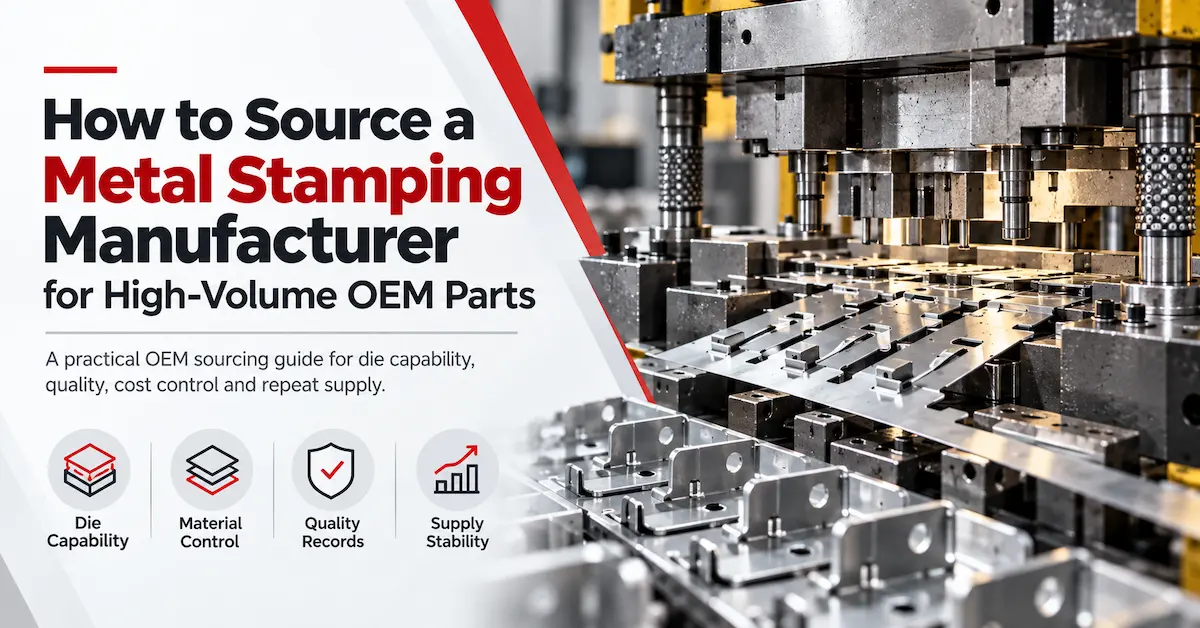
How to Source a Metal Stamping Manufacturer for High-Volume OEM Parts
Short answer: choose a metal stamping manufacturer that can connect the part drawing, strip or blank design, die construction, material control, press process, inspection records and delivery plan. For automotive, electronics and new-energy procurement, the best supplier is not simply the one with the lowest piece price. It is the manufacturer that can stabilize the die, hold the functional features, document the first article and repeat the approved part across the forecasted production life.
This guide is for buyers who are ready to request a quote or place a production program, not readers looking for a basic definition of stamping. It explains how to select a precision metal stamping supplier for conductive clips, brackets, shields, battery connection hardware, automotive hardware and other custom stamped metal parts. The decision framework covers progressive, transfer, compound and forming work, with particular attention to medium- and high-volume repeat orders.
The WLD metal stamping capability covers progressive and transfer stamping, complex forming, in-house tooling, process integration, carbon steel, stainless steel, aluminum and copper alloys, plus first-article, in-process and final checks. These documented capabilities are a starting point for a real RFQ. Your drawing, annual demand, material grade, tolerances and documentation requirements must determine the final quotation.
What is the fastest way to qualify a metal stamping manufacturer?
Start with five connected checks: confirm that the proposed die matches the geometry and annual volume; verify the exact material grade and thickness; identify the functional dimensions and inspection method; separate tooling cost from piece price; and obtain a written capacity, packaging and delivery plan. A supplier should be able to explain how each check is controlled before asking the buyer to release tooling.
- Process fit: die type, press route, secondary operations and known forming risks.
- Material control: grade, temper, thickness, coating, traceability and certificate requirements.
- Quality evidence: first article, critical dimensions, functional checks and reaction plan.
- Program economics: tooling scope, material utilization, unit price, maintenance and change cost.
- Supply continuity: forecasted capacity, packaging protection, delivery plan and revision control.
What should a buyer purchase from a stamping manufacturer?
A production stamping program is more than a shipment of metal parts. The purchase normally includes a manufacturing route and a set of controlled decisions:
- Part production: a repeatable press operation that forms, pierces, bends, draws or coins the specified geometry.
- Tooling: a die, progressive die, transfer die, compound die, fixture or checking method suited to the volume and material.
- Material assurance: the defined grade, temper, thickness, coil or sheet condition and traceability method.
- Quality evidence: first-article results, critical-dimension checks, visual standards, certificates and corrective-action records.
- Commercial continuity: a capacity, maintenance, packaging and delivery plan that protects repeat orders.
If a quote lists only a unit price, ask what is included in each of these five areas. A low piece price can become expensive when the die is excluded, the material is assumed rather than specified, the inspection report is missing or the packing method causes scratches and deformation.
| Procurement question | Evidence to request | Why it affects the order |
|---|---|---|
| Can the part run at the required volume? | Press route, die concept, annual demand review and capacity plan. | Prevents a prototype-capable supplier from being selected for a repeat production burden it cannot support. |
| What controls the functional features? | Datum scheme, die features, inspection method and first-article report. | Connects tooling decisions to fit, conductivity, assembly and interchangeability. |
| What will the buyer own? | Tooling ownership, maintenance responsibility, spare inserts and revision control. | Protects continuity when the design changes or the supplier relationship expands. |
| What is still project-specific? | MOQ, lead time, packaging, material certificate and special testing assumptions. | Stops generic promises from being mistaken for a contract commitment. |
When is stamping better than laser cutting or CNC machining?
Stamping is usually attractive when a part repeats in meaningful volume and the geometry can be built into a stable die sequence. The die investment is justified by cycle efficiency, consistent features and a lower cost per part after the program reaches its planned quantity. Laser cutting and CNC machining remain useful for prototypes, complex one-off geometry, thick materials or designs that are still changing.
Use stamping when repeatability and unit cost dominate
Progressive or continuous stamping can combine feeding, piercing, forming and cut-off in one controlled sequence. It is well suited to clips, terminals, brackets, shields, fixing hardware and other parts where the same features repeat across thousands or more pieces. A high volume metal stamping route can also reduce handling between operations and make inspection easier because the process sequence is defined.
Use a hybrid route when the part changes during development
Early samples may be produced by laser cutting, machining or a simple compound tool while the engineering team validates fit. Once the design, material and forecast stabilize, the supplier can compare a production die against the prototype route. This avoids forcing a production die decision before the interfaces are mature, while keeping the final production economics visible.
Do not decide from volume alone
Annual quantity is important, but material thickness, number of operations, tightness of the tolerance, surface requirements, coil availability, scrap value and die complexity also influence the break-even point. Ask the manufacturer to explain the assumptions behind the tooling and piece-price split. That conversation is more useful than a generic statement that “stamping is cheaper.”
How to choose progressive, transfer, compound or forming dies
The die architecture should follow the part and the production objective. A reputable manufacturer should be able to show the proposed sequence, identify the critical forming risks and explain why the selected die type is commercially appropriate.
Progressive dies for linked operations
A progressive die advances strip material through multiple stations. Piercing, notching, bending, coining and cut-off can be combined while the carrier maintains registration. This is effective for small and medium stamped parts with repeated features and high order quantities. Review strip width, pitch, carrier design, scrap direction, pilot strategy and the risk of springback or burrs at each station.
Transfer dies for larger or deeper parts
Transfer stamping moves a blank between separate stations, allowing larger parts, deeper draws or more open forming sequences. The design must account for transfer fingers, part presentation, draw beads, lubrication and access for inspection. Ask how the transfer path protects cosmetic surfaces and how the supplier will verify the part after multiple forming steps.
Compound dies for concentrated operations
A compound die performs multiple cutting operations in one press stroke, often with a strong focus on flatness, hole relationships and short process routes. It can be useful when the part has a compact geometry and the quantity justifies dedicated tooling but a multi-station progressive layout would add unnecessary complexity.
Deep drawing and complex forming
Deep drawing, flanging and complex forming require careful control of blank shape, draw ratio, lubrication, radii, material direction and intermediate operations. Cracking, wrinkles and thinning are not solved by press force alone. Request a DFM review that identifies the likely failure mode, the proposed die radius and the validation steps before production steel is released.
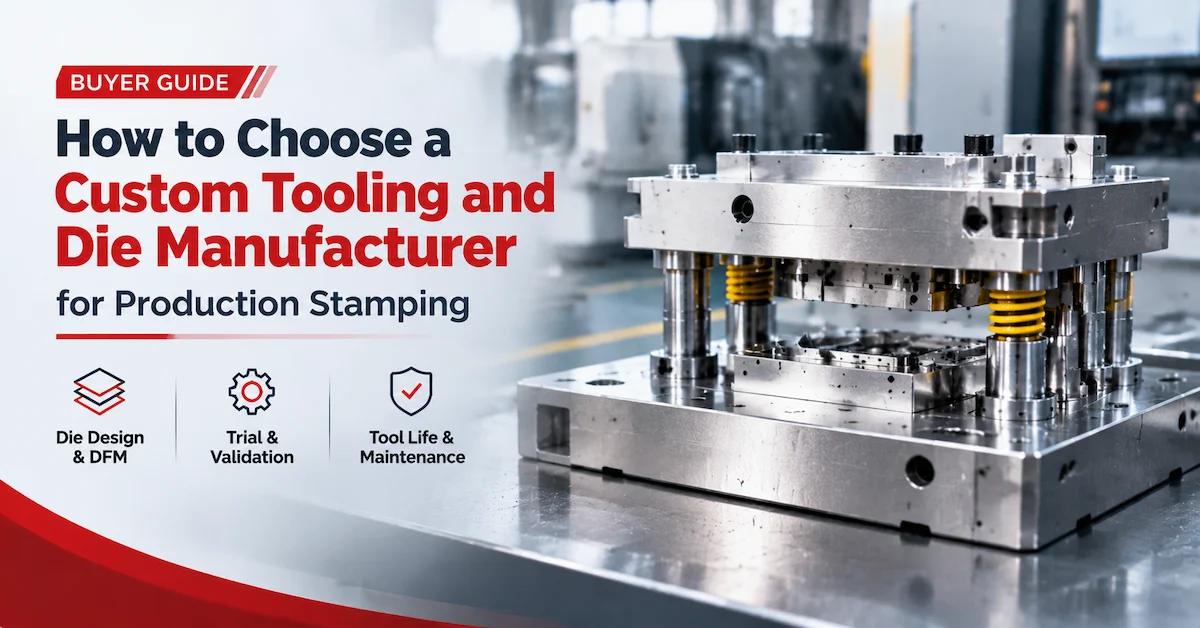
The WLD tooling and die manufacturing page describes progressive, transfer and compound dies, forming tools, DFM and DFA analysis, process simulation, T0/T1 trials and mass-production support. For an RFQ, ask the supplier to convert that capability statement into a die concept, trial plan and ownership schedule.
Which materials work for automotive, electronics and new-energy stamping?
Material selection affects press force, tool wear, springback, burr formation, conductivity, corrosion behavior, surface finish and final assembly. Name the exact grade and thickness in the drawing or RFQ. Terms such as “mild steel,” “aluminum sheet” or “copper strip” are not sufficient for a controlled production program.
| Material family | Typical stamped applications | RFQ controls | Common risk to review |
|---|---|---|---|
| Carbon and high-strength steel | Automotive brackets, structural hardware, clips and formed supports. | Grade, tensile range, thickness, coating and required forming direction. | Springback, cracking, burrs and corrosion protection after forming. |
| Stainless steel | Corrosion-resistant clips, shields, appliance hardware and demanding assemblies. | Grade, temper, surface condition, cleanliness and cosmetic acceptance. | Work hardening, tool wear, galling and visible marks. |
| Aluminum alloys | Lightweight brackets, battery hardware and electronic structural parts. | Alloy, temper, thickness, grain direction and surface finish. | Cracking, springback, burr control and surface damage. |
| Copper and copper alloys | Conductive terminals, busbar hardware, contacts and electrical clips. | Alloy, conductivity requirement, plating, burr limit and contact force. | Edge burrs, distortion, plating adhesion and resistance at the interface. |
The WLD stamping material overview identifies carbon steel, stainless steel, aluminum alloys and copper alloys as supported material families, with custom specifications based on application requirements. The electronics manufacturing page also describes progressive and continuous stamping for conductive clips, brackets, fixing clips, shielding covers and internal hardware.
For material verification, ask whether the lot is identified at receiving, how the material remains traceable after slitting or blanking, and which report accompanies the shipment. A supplier may use a handheld spectrometer or other equipment, but the acceptable grade, tolerance and documentation must come from your specification.
What should automotive buyers verify before awarding a stamping program?
Automotive stamping often combines high repeat volume with strict interchangeability, corrosion, appearance and traceability requirements. The supplier should understand how the stamped part interfaces with a body, seat, powertrain, battery, electrical or interior assembly. Ask for the functional characteristics first, then confirm the die and inspection approach that controls them.
Body and structural hardware
Brackets and structural hardware may need controlled hole position, flatness, strength and corrosion protection. A low unit price does not compensate for a hole pattern that shifts after forming or a bracket that cannot be assembled with the mating component. Request datum-based measurement, fixture strategy and a clear definition of the critical-to-function dimensions.
Electrical connectors and conductive parts
Terminals and conductive clips require more than dimensional control. Contact force, burr direction, plating, conductivity, retention and insertion behavior may all affect function. Define the contact surface, allowable tool marks, plating thickness or source, and any functional test that must accompany the first article or production batch.
New-energy vehicle programs
Battery and e-drive programs can combine lightweight alloys, conductive hardware, shielding, thermal requirements and a long production horizon. WLD’s automotive manufacturing information describes volume stamping for structural parts, conductive connectors and interior hardware, while its new-energy manufacturing information connects progressive and continuous stamping with battery connection hardware and chassis stamping parts. Use those capability signals to start a technical conversation, then qualify the actual program requirements.
Automotive buyers should also ask whether the supplier can support engineering changes without losing the approved baseline. Record the die revision, material revision, inspection revision and effective purchase-order date together. This is a practical control for repeat orders and avoids a disagreement about which version was approved.
What should electronics buyers verify for precision stamped parts?
Electronics stamping is often driven by compact geometry, high repeatability, burr control, plating or surface requirements and assembly speed. The part may be small, but the cost of a defect can be high when it causes a connector failure, shielding problem or line stoppage.
- Feature scale: confirm the smallest hole, slot, web and formed radius that the material and die can hold consistently.
- Contact and shielding surfaces: identify which surfaces are functional and which marks are acceptable.
- Burr direction: specify how the cut edge must face during assembly and whether deburring or secondary treatment is allowed.
- Plating or coating: define the substrate, masking, thickness, appearance and adhesion evidence.
- Inspection frequency: align sampling with the risk of line stoppage, not only the nominal part quantity.
According to WLD’s electronics manufacturing information, its relevant controls can include incoming inspection, FAI, process-routing inspection, process inspection and final dimensional, visual and assembly-fit checks. Confirm which controls apply to your drawing and whether the requested reports are included in the quote.
How can stamping tooling reduce or increase total cost?
Tooling cost is visible, but the bigger commercial question is total cost over the program: die design and build, material utilization, cycle rate, maintenance, scrap, secondary operations, inspection, packaging and the cost of a late change. A serious quotation separates these drivers instead of hiding them inside an unexplained piece price.
Material utilization and strip layout
Strip width, pitch, carrier design and nesting determine how much material becomes product and how much becomes scrap. Ask for the assumed material size and whether the quoted yield depends on a specific coil width. A layout change can lower piece cost, but it may also change carrier strength, burr direction or the ability to inspect the part in the die.
Operation count and secondary work
Combining operations can improve throughput, but a more complex die may increase build time, maintenance sensitivity and change cost. Conversely, a simple die plus a secondary operation may be easier to maintain but slower or less consistent. Request a route comparison when the design has several plausible manufacturing options.
Maintenance and spare components
A production die is an asset that needs a maintenance plan. Ask which wear components are expected, how spares are identified, who pays for scheduled maintenance and how quickly a damaged insert can be replaced. WLD’s tooling capability information describes maintenance plans, spare-parts lists and mass-production support.
When comparing quotes, calculate a program-level view: tooling amortization plus piece price at the forecast quantity, then add inspection, packaging and logistics assumptions. Do not optimize only for the first 1,000 pieces if the purchase order is intended to run for several years.
| Cost driver | Question to ask | Commercial decision |
|---|---|---|
| Die build | What die type, material and trial stages are included? | Approve the tool budget against expected life and volume. |
| Piece price | Does the price include material, press time, secondary work and inspection? | Compare like-for-like scope across suppliers. |
| Scrap and yield | What strip width, pitch and material utilization are assumed? | Check whether the savings are real at the specified coil or sheet size. |
| Change control | What happens when the drawing, material or forecast changes? | Protects the buyer from unplanned rework and obsolete tooling. |
| Maintenance | Which inserts, spares and scheduled services are included? | Protects uptime and repeat-order continuity. |
How should quality be documented for stamped metal parts?
Quality should be described as a sequence of evidence, not as a certificate alone. The sequence normally starts with material receipt, moves through die setup and first-article approval, continues with process checks, and ends with final inspection, packaging verification and shipment records.
Incoming material and die readiness
Confirm material identity, thickness, surface condition and lot traceability before the first run. Before production, verify die revision, press setup, lubrication, feeder settings, pilot condition and the inspection method for critical features. A first-piece approval is useful only when the drawing revision and acceptance criteria are explicit.
In-process control
In-process checks should target burrs, hole position, pitch, form height, bend angle, flatness, cracks, springback, contact force or other characteristics that can drift during a run. Define the frequency, reaction plan and disposition of suspect product. For a high-volume order, the supplier should be able to show how a process change is recorded rather than relying on verbal communication.
Final inspection and traceable records
Request the report format before the purchase order. Depending on the part, it may include material certificates, first-article inspection, dimensional results, visual standards, plating or coating evidence, functional checks, certificate of conformity and packaging photographs. The WLD quality assurance page describes raw-material inspection, process control and final inspection and lists CMMs, projectors, a handheld spectrometer, height and contour equipment, a metallographic microscope and a roughness tester.
WLDs electronics and renewable-energy pages describe FAI, dimensional reports, material reports, CMM reports and certificates of conformity as documentation options for relevant supply chains. Confirm which documents are contractually required for your project; do not assume every public option is included automatically.
“From First Article Inspection (FAI) to in-process and final checks.”Source: WLD Metal Stamping capability page
MOQ, lead time, packaging and capacity for a stamping RFQ
Procurement teams need a commercial answer, but custom stamping variables make universal promises unreliable. The WLD stamping page describes scalable medium- to high-volume production, production planning and global delivery, but it does not publish one universal MOQ or one fixed lead-time table for every stamped part. Treat MOQ and lead time as RFQ fields that depend on material, die complexity, trial status, inspection and forecast.
| Commercial field | What to include in the RFQ | What the supplier should clarify |
|---|---|---|
| MOQ and order quantity | Prototype quantity, pilot batch, annual volume, release pattern and peak demand. | Material minimum, setup economics, die amortization and whether a smaller first run is possible. |
| Lead time | Required sample date, SOP date, forecast and approval milestones. | DFM, die design, build, T0/T1 trials, corrections, FAI, production, finishing and export transit. |
| Packaging | Part orientation, separators, rust protection, labels, carton limits and pallet rules. | How the package prevents tangling, burr damage, deformation, scratches and mixed lots. |
| Capacity | Annual demand, monthly releases, peak month and program duration. | Press availability, die maintenance windows, material supply and backup plan. |
WLDs company profile states that the Shenzhen manufacturer was founded in 2003, operates more than 100 machines and has company-level capacity of up to 50,000 parts per month. This is useful context for a supplier conversation, not a guarantee that any individual stamped part can run at that rate. Ask for a route-specific capacity review and written assumptions.
Packaging deserves the same precision as the die. Small stamped parts can tangle, nest incorrectly, lose surface protection or mix revisions during export. Include the packaging standard in the quote and approve a sample package before the first recurring shipment.
What to send when requesting a stamping quote
A transaction-ready RFQ lets a metal stamping manufacturer price the actual process instead of guessing. Send the following as one controlled package:
- 2D drawing with revision, datums, tolerances, material, thickness and surface requirements.
- 3D model when the part has complex forming, assembly interfaces or cosmetic geometry.
- Annual demand, first order quantity, release schedule, ramp plan and forecast range.
- Part family information when several stamped components may share material, tooling or packaging.
- Functional characteristics such as hole position, contact force, flatness, conductivity, retention or assembly fit.
- Plating, coating, deburring, cleaning, oiling, heat treatment or other secondary-process requirements.
- FAI, PPAP-style, dimensional, material, functional or certificate-of-conformity requirements.
- Tooling ownership, expected tool life, maintenance responsibility and spare-insert expectations.
- Destination, delivery terms, packaging, label format and required shipment date.
- Questions the supplier should answer during DFM, including strip layout, die type and risk features.
The WLD contact page asks buyers to provide material, dimensions, quantity and specific project requirements for technical review and quotation. Use the same principle for any supplier: a clear RFQ produces a more useful answer and makes later quote comparisons fair.
Frequently asked questions about metal stamping manufacturers
What does a metal stamping manufacturer produce?
A metal stamping manufacturer converts sheet or coil into repeatable parts through punching, blanking, bending, forming, drawing, coining or related press operations. Typical products include brackets, clips, terminals, shields, conductive hardware, battery connection parts, automotive hardware and appliance components.
What is the difference between a stamping manufacturer and a die maker?
A stamping manufacturer runs the production process and delivers parts; a die maker designs and builds the tooling. Some suppliers integrate both responsibilities. For a long-term project, ask who owns the die design, who maintains it, who controls revisions and who is responsible when a trial result misses a functional requirement.
Is progressive stamping suitable for high-volume OEM parts?
It can be suitable when the part has linked operations, stable geometry and enough quantity to justify the die. The supplier should review strip layout, material, press capacity, cycle rate, scrap, inspection and maintenance before confirming the route. Progressive is not automatically the best option for every high-volume shape.
How much does metal stamping tooling cost?
Tooling cost depends on die type, part size, material, number of stations, tolerances, forming depth, expected life, trial requirements and change risk. Request a separate tooling line and a clear scope for design, build, T0/T1 trials, corrections, spare parts and maintenance. A piece price without tooling assumptions is not a complete comparison.
What MOQ should I expect for custom stamped parts?
There is no universal MOQ. Material minimums, setup effort, die economics, inspection, packaging and the buyer’s forecast all affect the practical batch size. Ask for separate assumptions for prototype, pilot and recurring production. WLD’s public pages do not publish one universal MOQ, so confirm it in the project RFQ.
What quality documents should accompany the first production run?
Depending on the application, request material certification, first-article inspection, dimensional results, visual criteria, functional checks, plating or coating evidence, certificate of conformity and a packaging record. Automotive, electronics and new-energy programs may add customer-specific formats or traceability requirements.
Can a stamping supplier support automotive, electronics and new-energy parts?
A supplier may support all three, but the evidence is application-specific. Automotive parts may emphasize interchangeability and corrosion; electronics parts may emphasize burrs, plating and contact behavior; new-energy parts may emphasize lightweight materials, conductivity, outdoor protection and repeatability. Review the actual drawing and quality requirements with the engineering team.
How do I request a quote from WLD Technology?
Prepare the drawing, material, thickness, quantity, finish, inspection requirements, tooling expectations, packaging and destination. Use the WLD contact page to submit the project information for technical review and quotation.
Conclusion
The right metal stamping manufacturer for an automotive, electronics or new-energy program is the one that can make the complete production route visible: material, die, press sequence, inspection, maintenance, packaging and delivery. Compare the total program cost and evidence, not only the quoted piece price.
For a practical next step, send a controlled drawing package with material, annual volume, functional dimensions, finish, inspection records, tooling ownership and packaging requirements. WLD Technology publicly describes progressive and transfer stamping, in-house tooling, DFM support, quality inspection and global delivery. Turn those capabilities into a part-specific quotation and confirm MOQ, lead time, die scope and quality documents before release.